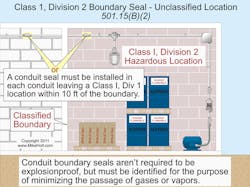
Q. Where does the Code require a boundary seal when leaving a Class I, Division 2 location and entering an unclassified area?
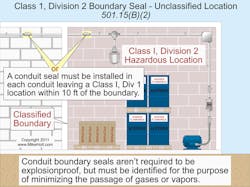
A. A raceway seal fitting must be installed in each raceway that passes from a Class I, Division 2 location into an unclassified location within 10 ft of the Class I, Division 2 area on either side of the boundary [501.15(B)(2)] (see Figure below).
Rigid metal conduit (RMC) or threaded steel intermediate metal conduit (IMC) must be used between the sealing fitting and the point at which the raceway leaves the Division 2 location, and a threaded connection must be used at the sealing fitting. Except for listed reducers at the raceway seal, there must be no union, coupling, box, or fitting between the raceway seal and the point at which the raceway leaves the Division 2 location.
Raceway boundary seals aren't required to be explosionproof, but must be identified for the purpose of minimizing the passage of gases under normal operating conditions, and they must be accessible. See the definition of "Accessible" as it relates to wiring methods.
The raceway boundary seal at unclassified locations is to minimize the passage of gases or vapors, not to contain explosions in the raceway system.
Here are three Exceptions to rule 501.15(B)(2) to take note of:
Exception 1: A raceway boundary seal fitting isn't required for a raceway that passes through the Class I, Division 2 area unbroken with no fittings less than 1 ft beyond the boundary to an unclassified location.
Exception 2: A raceway boundary seal fitting isn't required for raceways that terminate at an outdoor unclassified location for cable trays, cablebus, ventilated busways, MI cable, or open wiring.
Exception 3: A boundary seal fitting isn't required for a raceway that passes from an enclosure or room that's unclassified as a result of pressurization into a Class I, Division 2 location.
About the Author

Mike Holt
Mike Holt is the owner of Mike Holt Enterprises (www.MikeHolt.com), one of the largest electrical publishers in the United States. He earned a master's degree in the Business Administration Program (MBA) from the University of Miami. He earned his reputation as a National Electrical Code (NEC) expert by working his way up through the electrical trade. Formally a construction editor for two different trade publications, Mike started his career as an apprentice electrician and eventually became a master electrician, an electrical inspector, a contractor, and an educator. Mike has taught more than 1,000 classes on 30 different electrical-related subjects — ranging from alarm installations to exam preparation and voltage drop calculations. He continues to produce seminars, videos, books, and online training for the trade as well as contribute monthly Code content to EC&M magazine.