Typically, switchboard work is part of a larger project such as a service installation. In some projects, switchboard and panelboard installation may be taking on a new twist, with distributed generation applications such as small wind and solar installations.
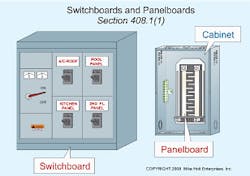
Fig. 1. Article 408 contains the requirements for switchboards, panelboards, and distribution boards for light and power.
Modification of existing buildings for alternative power sources is increasingly showing up on the project lists for many companies. For example, Art. 690 applies if the alternative source is solar. Keep in mind that the Art. 690 aspects comprise a minor part of a much larger project that must meet the requirements from NEC Chapters 1 through 4 [90.3]. For example, Chapter 4 includes the requirements for switchboards and panelboards.
Whether you're doing a new service installation or a modification, Art. 408 applies. This Article provides the specific requirements for switchboards and panelboards. It also covers distribution boards that control power and lighting circuits (Fig. 1).
Busbar and conductor arrangement
If using panelboards for service equipment, provide each one with a main bonding jumper to connect the service neutral conductor to the panelboard’s metal frame [408.3(C)]. The main bonding jumper is sized in accordance with 250.28(D)(1), which refers us to Table 250.66 for services with ungrounded conductors up to 1,100kcmil. When the ungrounded conductor is larger than 1,100kcmil, the main bonding jumper must be sized with an area that is at least 12.5% of the largest phase conductor.
Caution: Be sure to locate the terminals for neutral and equipment grounding conductors so a person doesn’t have to reach beyond live parts to make connections.
High legs
If a 4-wire, delta-connected, 3-phase (high-leg) system supplies a panelboard, the high-leg (or wild-leg) conductor, which operates at 208V to ground, must be terminated to the "B" phase of the panelboard.
Prior to 1975, the high-leg conductor was terminated on the "C" phase of panelboards and switchboards. After the 1975 Code revision, the requirement changed to the current practice of placing the wild-leg on the "B" phase [408.3(E)]. However, there's an exception to this rule, which allows the high-leg conductor to terminate on the same phase as the metering equipment when the meter is in the same section of a switchboard or panelboard. In fact, the ANSI standard for meter equipment requires the high-leg conductor (208V to neutral) to terminate on the "C" (right) phase of the meter socket enclosure. This is because the demand meter needs 120V, which is obtained from the "B" phase.
If you are doing any revision or replacement of a panelboard or other equipment that is supplied by a delta-connected high-leg system, be sure to replace the high-leg conductor in its original location. Otherwise, you may inadvertently connect 120V circuits to the 208V high leg, which would have disastrous results.
Be sure to properly identify the high-leg conductors. Use orange identification, or some other effective means [110.15 and 230.56]. Switchboards and panelboards containing a 4-wire, delta-connected system where the midpoint of one phase winding is grounded (high-leg system), must be legibly and permanently field-marked with the following: "Caution: B Phase has 208V to Ground" [408.3(F)].
The fire department's perspective
Ask any fire marshal what is most irritating about the typical electrical installation, and you’ll likely get the following the answer: "Trying to figure out which breaker controls what."
Case study: The local fire department responded to an automatic trouble call at the administrative offices of an appliance factory in Tennessee. Unable to determine which breaker controlled which branch circuit, the fire chief issued an order to open all of the breakers. This put two floors of the building in the dark, rather than just the one room in question. Only then did the fire crew enter the affected area.
The incident resulted in a fine for NEC violations and a report to the insurance company. Proper directory labeling on the panelboard cover would have prevented this, interruption in operations as well as the ensuing fine. If this had been a service panel, rather than just a branch circuit panel, the consequences could have even been more severe.
Make sure you legibly mark all circuits, and circuit modifications, as to their clear, evident, and specific purpose [408.4]. That includes spare positions that contain unused overcurrent devices. Identification must include sufficient detail to allow each circuit to be distinguished from all others. The identification must be on a circuit directory on the face or inside of the door of the panelboard and must not be based on transient conditions of occupancy.
Enclosures
Where raceways enter a switchboard, floor-standing panelboard, or similar enclosure, the raceways (including end fittings) must not rise more than 3 in. above the bottom of the enclosure [408.5].
Any unused openings for circuit breakers and switches must be closed [408.7]. Use identified closures or other means approved by the AHJ that provide protection substantially equivalent to the wall of the enclosure.
Overcurrent protection
You must provide each panelboard with overcurrent protection. Locate the overcurrent protection device (OCPD) within, or at any point on the supply side of, the panelboard [408.36]. The rating of this overcurrent protective device must not exceed that of the panelboard.
Individual overcurrent protection is not required for panelboards used as service equipment in situations as covered by 230.71 [408.36, Ex. 1].
When a panelboard is supplied from a transformer, as permitted in 240.21(C), the overcurrent protection for the panelboard must be on the secondary side of the transformer. The required overcurrent protection can be in a separate enclosure ahead of the panelboard, or it can be in the panelboard (Fig. 2).
Don't install more overcurrent devices than the number for which the panelboard is designed, rated, and listed. When applying this rule, a 2-pole circuit breaker is considered to be two overcurrent devices, and a 3-pole circuit breaker is considered to be three overcurrent devices [408.54].
Backfed breakers
If you use plug-in circuit breakers that are back-fed from field-installed conductors to serve as a main breaker in a "main-lug-only" panel, secure the breaker in place by an additional fastener that requires something other than a pull to release the breaker from the panelboard (Fig. 3).
The purpose of the breaker fastener is to prevent the circuit breaker from being accidentally removed from the panelboard while energized, thereby exposing someone to dangerous voltage. Circuit breakers are often back-fed to provide the overcurrent protection for panelboards, as required by 408.36. Circuit breakers marked "Line" and "Load" must be installed per their listing or labeling instructions [110.3(B)]; therefore, these types of devices must not be back-fed.
Damp or wet locations
Article 408 covers the requirements for switchboards and panelboards. When the Code refers to a panelboard, it is referring to the interior or "guts" of the panelboard. The enclosure that the panelboard is mounted inside of is called a cabinet by the NEC and is covered by Art. 310. The enclosures (cabinets) for panelboards must prevent moisture or water from entering or accumulating within the enclosure, and they must be weatherproof when used in a wet location [312.2]. When the enclosure is surface mounted in a wet location, the enclosure must be mounted with at least 1⁄4 in. air space between it and the mounting surface [312.2 and 408.37].
Equipment grounding conductor
Metal panelboard cabinets and frames must be connected to an equipment grounding conductor (EGC) of a type recognized in 250.118 [215.6 and 250.4(A)(3)].
Where the panelboard cabinet is used with nonmetallic raceways or cables — or where separate equipment grounding conductors are provided — a terminal bar for the circuit equipment grounding conductors must be bonded to the metal cabinet [408.40]. But insulated equipment grounding conductors for receptacles having insulated grounding terminals (isolated ground receptacles) [250.146(D)] can pass through the panelboard without terminating onto the equipment grounding terminal of the panelboard cabinet [408.40 Ex]. Equipment grounding conductors must not terminate on the neutral terminal bar, and neutral conductors must not terminate on the equipment grounding terminal bar, except as permitted by 250.142 for services and separately derived systems.
Most panelboards are rated as suitable for use as service equipment, which means they’re supplied with a main bonding jumper, which is usually a screw or strap [250.28]. Don't install this jumper, unless you're using the panelboard for service equipment [250.24(A)(5)] or separately derived systems [250.30(A)(1)]. In addition, a panelboard marked "suitable only for use as service equipment" means the neutral bar or terminal of the panelboard has been bonded to the case at the factory. Don't use this panelboard for anything other than service equipment or on separately derived systems in accordance with 250.142(B).
Neutral terminations
Each neutral conductor within a panelboard must terminate to an individual terminal [408.41] — that is, don't put two neutrals on the same termination point. Why does this rule exist? One very good reason is that if two neutral conductors are connected to the same terminal and someone removes one of them, the other neutral conductor might unintentionally be removed as well. If that happens to the neutral conductor of a multiwire circuit, the likely result is excessive line-to-neutral voltage for one of the circuits and undervoltage for the other circuit.
This requirement doesn’t apply to equipment grounding conductors, because removing an equipment grounding conductor doesn’t affect the voltage of a circuit (Fig. 4).
Keep it clear
To keep Art. 408 clear in your mind, remember its primary goal is to prevent contact between current-carrying conductors and people or equipment. To satisfy that goal means following detailed requirements for bonding, grounding, and overcurrent protection. But don't forget it has some other goals as well, such as assisting first responders to quickly locate and identify the disconnecting means for a specific room or area of a building in order to respond properly to a life-threatening emergency. Be sure to fill out panel directories accurately, legibly, and with sufficient detail to aid emergency personnel in situations where every second counts.
About the Author

Mike Holt
Mike Holt is the owner of Mike Holt Enterprises (www.MikeHolt.com), one of the largest electrical publishers in the United States. He earned a master's degree in the Business Administration Program (MBA) from the University of Miami. He earned his reputation as a National Electrical Code (NEC) expert by working his way up through the electrical trade. Formally a construction editor for two different trade publications, Mike started his career as an apprentice electrician and eventually became a master electrician, an electrical inspector, a contractor, and an educator. Mike has taught more than 1,000 classes on 30 different electrical-related subjects — ranging from alarm installations to exam preparation and voltage drop calculations. He continues to produce seminars, videos, books, and online training for the trade as well as contribute monthly Code content to EC&M magazine.