What's Wrong Here? Hint: This Emergency System Needs an Immediate Fix
How well do you know the Code? Think you can spot violations the original installer either ignored or couldn't identify? Here's your chance to moonlight as an electrical inspector and second-guess someone else's work from the safety of your living room or office. It's your turn to identify the violation.
Hint: this emergency system needs an immediate fix
Find the Answer
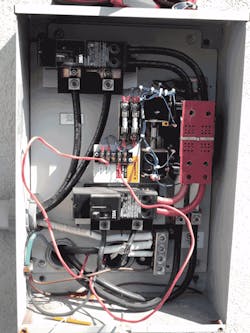
"We were hired to relocate a generator and its transfer switch," says Steve Tate of White Sands Electric, Pensacola, Fla. "Here is what we found!"
"If you notice the 240V sensing voltage is connected from the automatic transfer switch to the generator using 18/2 AWG fire wire. The same type of cable is used for the 12V DC battery charger, which is not as dangerous but probably not very effective. They also ran the cable through a ¼ in. drilled hole instead of a bushed connector of any sort. Then it ran free air on the trapeze. The cables are simply strung along the Unistrut trapeze with the conduit (open air) about 9 ft up."
This basic rule comes to mind when I review this commentary and these photos.
As noted in 700.5(A), "Transfer equipment, including automatic transfer switches, shall be automatic, identified for emergency use, and approved by the authority having jurisdiction. Transfer equipment shall be designed and installed to prevent the inadvertent interconnection of normal and emergency sources of supply in any operation of the transfer equipment. Transfer equipment and electric power production systems installed to permit operation in parallel with the normal source shall meet the requirements of Article 705."
Following the manufacturer instructions that come with this type of equipment is the best way to be sure that it is installed properly.
> Try Another Quiz
About the Author
Joe Tedesco
Tedesco served the industry in many roles during his career. He was a director, senior electrical code instructor for National Technology Transfer, Inc. and American Trainco, Inc.. He was also a codes, standards and seminar specialist for the International Association of Electrical Inspectors and an electrical field service specialist for the National Fire Protection Association in Quincy, Mass. He ran his own business as an NEC consultant and is a Massachusetts licensed master electrician and journeyman electrician and certified electrical inspector (one and two family 2A; General 2B, and Plan Review, 2C). Tedesco also wrote articles for CEE News and EC&M (Code Violations Illustrated and What's Wrong Here?) for more than 15 years and helped launched the Moving Violations video series.