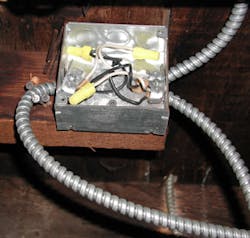
Here’s your chance to moonlight as an electrical inspector and second-guess someone else’s work from the safety of your living room or office. Can you identify the Code violation(s) in this photo?
Hint: Recognized means of support
Find the Answer
How well do you know the Code? Think you can spot violations the original installer either ignored or couldn't identify? Here's your chance to moonlight as an electrical inspector and second-guess someone else's work from the safety of your living room or office. Can you identify the Code violation(s) in this photo?
September Winners
Our three winners this month were: Michael McCarty, owner, Glow-Brite Electric Co., Dacula, Ga.; Rick Williams, president, Williams Electrical Service, Inc., Pasadena, Md.; and Ron Patterson, owner, Patterson Electric Co., Dillon, Colo. Here's a list of the most noticeable Code violations these three associated with this octopus-like handy box arrangement.
Of the many violations identified by readers, 110.12 “Mechanical Execution of Work” was on virtually everyone's list. The first sentence of this section requires electrical work to be performed in “a neat and workman-like manner.” Although that wording is somewhat subjective in terms of actual enforcement, this installation clearly fails to meet that criterion.
Section 200.7 was another popular pick. This rule essentially reserves the use of white, gray, and white stripes on any color insulation other than green for the “grounded conductor.” Remember, although the “grounded conductor” is generally a neutral conductor, such as in typical 208Y/120V and 480Y/277V grounded systems, it could also be a phase conductor, such as in the “corner-grounded” 480V or 240V delta systems.
The rules for box fill, given in 314.16, were also nearly universally referenced. It seems very clear that this outlet box is in violation of these requirements. By limiting the number of current-carrying conductors within a box, the heat generated will be allowed to dissipate before reaching a temperature that will cause the conductors' insulation to start breaking down.
One of the other commonly cited Code violations related to 400.7, which covers “Uses Permitted” for flexible cords. This application is not among the many specific uses identified by this rule. Part (B) to 400.7 only recognizes the supply of flexible cords from a receptacle, not to a receptacle. Additionally, 400.8 can be referenced because subpart (1) to that rule prohibits flexible cord from being used “as a substitute for fixed wiring of a structure.”
‘TELL THEM WHAT THEY'VE WON…’
Using the 2008 NEC, correctly identify the Code violation(s) in this month's photo — in 200 words or less — and you could win something to put in your tool-box. E-mail your response to [email protected], and he'll select three winners (excluding manufacturers and prior winners) at random from the correct submissions. Winners will receive a set of insulated hand tools from Ideal Industries, Inc., valued at more than $125.* The set includes 9.25-in. insulated side-cutting pliers, 10-in. insulated tongue-and-groove pliers, and a 0.25-in. ÷ 6-in. insulated screwdriver. (* Please allow six to eight weeks for delivery of tools.)