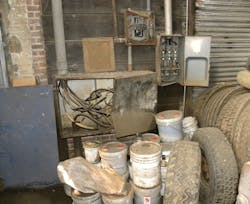
How well do you know the Code? Think you can spot violations the original installer either ignored or couldn't identify? Here's your chance to moonlight as an electrical inspector and second-guess someone else's work from the safety of your living room or office. Brian, who has a knack for finding shoddy electrical work, did the dirty work and found this mess. Now it's your turn to identify the violation.
Find the Answer
Here's a reality that we've all confronted on multiple occasions. The location of "foreign" material in front of electrical equipment constitutes a violation of 110.26. Additionally, the fact that this equipment has been damaged by vehicular collisions — it's a warehouse where trucks come in and out all day — the rule of 110.27(B) has also been violated.
The first paragraph of 110.26 says, "Sufficient access and working space shall be provided and maintained about all electrical equipment to permit ready and safe operation and maintenance of such equipment."
The first part of that rule is relatively easy to satisfy. All one needs to do is ensure that the area described by subsequent parts of 110.26 (i.e., a depth of 3 ft to 4 ft, depending on voltage and conditions of use [(A)(1)]; a width of 30 in. or the width of equipment, whichever is greater [(A)(2)]; and a height of 6.5 ft or the equipment height, whichever is greater[(A)(3)]) be provided. The second part — maintaining the work space — is impossible for the electrical installer to control. That, by default, leaves the property owner to ensure the provided work space remains clear. To assist the owner, I've seen installations where the electrical contractor will outline the work space with paint on the floor in front of the equipment. Although that’s a good idea, it is above and beyond what the actual wording of 110.26 requires.
The other concern here is the lack of physical protection for the electrical equipment. In 110.27(B), the Code says, "In locations where electrical equipment is likely to be exposed to physical damage, enclosures or guards shall be so arranged and of such strength as to prevent such damage." While maintenance of the work space is the owner's responsibility, it is up to the electrical installer to anticipate whether the equipment needs additional protection, such as bollards, and then to provide such protection.
It should be noted that where protection is deemed necessary, any such protection must not be installed within the required work space. So, where bollards or other barriers are installed to satisfy 110.27(B), they must not be closer to the equipment than 3 ft, which also ensures compliance with 110.26. Remember, if two rules apply to a given application, then both must be satisfied.