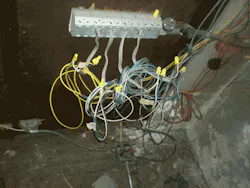
How well do you know the Code? Think you can spot violations the original installer either ignored or couldn't identify? Here's your chance to moonlight as an electrical inspector and second-guess someone else's work from the safety of your living room or office. Joe, who has a knack for finding shoddy electrical work, did the dirty work and found this mess. Now it's your turn to identify the violation.
Find the Answer
"This is a photo I recently took at a church," says Charles L. Nix, II of McDonald, Tenn. "The rear of the boxes house the switches for the main sanctuary lights. They were installed about 15 to 20 years ago."
Nix goes on to say, "I know you get a lot of photos, but I thought with the conduit violations, lack of conductor support, no prevention of abrasion, missing junction boxes, and the other items of concern these photos might create a record number of Code sections violated."
Well Charles, this installation does give us a whole lot to think about. First, all of these cables are subject to physical damage, and the splices need to be placed inside properly sized boxes, as clearly noted in Art. 314. Another key section of the NEC we can reference as being violated is 334.15 [Exposed Work]. In exposed work, except as provided in 300.11(A), cable shall be installed as specified in 334.15(A) through (C).
(A) — "Cable shall closely follow the surface of the building finish or of running boards."
(B) — "Cable shall be protected from physical damage where necessary by rigid metal conduit, intermediate metal conduit, electrical metallic tubing, Schedule 80 PVC conduit, Type RTRC marked with the suffix -XW, or other approved means. Where passing through a floor, the cable shall be enclosed in rigid metal conduit, intermediate metal conduit, electrical metallic tubing, Schedule 80 PVC conduit, Type RTRC marked with the suffix -XW, or other approved means extending at least 150 mm (6 in.) above the floor. Type NMC cable installed in shallow chases or grooves in masonry, concrete, or adobe shall be protected in accordance with the requirements in 300.4(F) and covered with plaster, adobe, or similar finish."
> Try Another Quiz
About the Author
Joe Tedesco
Tedesco served the industry in many roles during his career. He was a director, senior electrical code instructor for National Technology Transfer, Inc. and American Trainco, Inc.. He was also a codes, standards and seminar specialist for the International Association of Electrical Inspectors and an electrical field service specialist for the National Fire Protection Association in Quincy, Mass. He ran his own business as an NEC consultant and is a Massachusetts licensed master electrician and journeyman electrician and certified electrical inspector (one and two family 2A; General 2B, and Plan Review, 2C). Tedesco also wrote articles for CEE News and EC&M (Code Violations Illustrated and What's Wrong Here?) for more than 15 years and helped launched the Moving Violations video series.