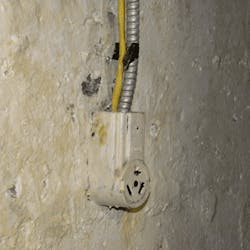
How well do you know the Code? Think you can spot violations the original installer either ignored or couldn't identify? Here's your chance to moonlight as an electrical inspector and second-guess someone else's work from the safety of your living room or office. Brian, who has a knack for finding shoddy electrical work, did the dirty work and found this mess. Now it's your turn to identify the violation.
Find the Answer
This surface-mounted dryer receptacle, being fed with a 10/3 Type AC cable that is protected by a 2-pole, 30A circuit breaker, was discovered in the basement of an existing residence. But what's that lovely little yellow covered conductor doing there, you ask? Well, some fool decided to add a 12/2 Type NM cable to the mix and serve a different load. This is a clear violation of the rule in 110.3(B) and the requirement in 240.4(D).
As most are aware, 110.3(B) [Installation and Use] says, "Listed and labeled equipment shall be installed and used in accordance with any instructions included in the listing or labeling." When this device was submitted for listing, it was only meant to be fed by a single circuit and supply a single load. Given that reality, the amount of space within the device was evaluated and tested on that basis. It's hard to imagine how the installer even got the additional conductors in the there, but somehow they did.
An even bigger concern is the rating of the overcurrent protective device. The requirements of 240.4(D) place limitations on the overcurrent protection permitted for the so-called "smaller conductors" (i.e., 14, 12, and 10 AWG). As given in this section of the Code, "unless specifically permitted in 240(E) or (G), the overcurrent protection shall not exceed that required by [sections] (D)(1) through (D)(7) after any correction for ambient temperature and number of conductors has been applied." In addition, (D)(5) limits protection of 12 AWG copper conductors to not more than 20A.
Table 310-16 indicates a 12 AWG copper conductor with 90°C-rated insulation has an ampacity of 30A, where the conditions of use are as described in the table heading. But, if this conductor were protected by a 30A breaker, under short circuit conditions the breaker would not be capable of opening the circuit before the conductor fused "open." However, if a 20A breaker is used, the short would clear before the conductor melted. The same reality exists in 14 AWG and 10 AWG sized wire. Therefore, the so-called "small conductors" must be protected as directed by 240.4(D).