What’s Wrong Here? Hint: Shave and a Trim
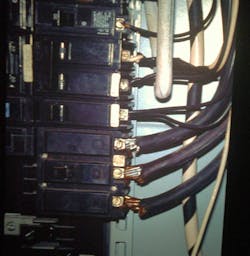
How well do you know the Code? Think you can spot violations the original installer either ignored or couldn't identify? Here's your chance to moonlight as an electrical inspector and second-guess someone else's work from the safety of your living room or office. It's your turn to identify the violation.
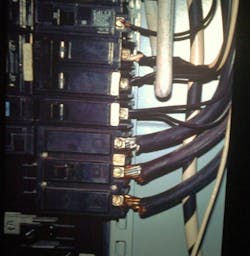
Hint: How about a shave and a trim?
Find the Answer
It looks as though this installer gave a "haircut" to the conductors he landed on the 3-pole breaker at the bottom right of the photo. Because the conductors were too large to cram into the small terminals, the installer simply chopped off enough of the individual strands to make them fit.
Chopping the strands off could certainly create a "hot spot" on the wires, because they are no longer able to carry the full amount of current they were rated for. This could also be a violation of 210.19(A), if those chopped branch circuit conductors no longer have the ampacity required to serve the maximum load they serve. It is most definitely a violation of 110.14(A), which requires that wire connections to terminals must ensure "a thoroughly good connection" is made without damaging the conductors.
On the breakers in the upper part of the photo, you'll notice multiple conductors twisted together and jammed into the terminals. This would also be a violation of 110.14(A). The last paragraph of this section of the NEC requires terminals for aluminum conductors or more than one conductor to be identified as such.
Any of the lousy conductor terminations here could also be a violation of 310.15(A)(3), since they are being used or associated in a manner that could cause the temperature limits of the conductors to be exceeded.
About the Author

Russ LeBlanc
Owner
Russ started in the electrical trade as an apprentice in 1985. He worked his way up to become a Journeyman Electrician and then eventually became a Master Electrician and Licensed Construction Supervisor. In 1999 Russ become an Electrical Instructor for The Peterson School of Engineering in Massachusetts where he developed his passion for teaching, and quickly became Department Head of Electrical Instruction. Russ has taught thousands of apprentices, electricians, engineers, inspectors, and other electrical professionals during his career as an instructor. He continues to provide electrical professionals with Electrical Code seminars, Arc-Flash Awareness training seminars and educational material through his LeBlanc Consulting Services in North Reading, MA whose specialty is educating electricians. He has been an active member of the NFPA Electrical Section and has authored hundreds of National Electrical Code proposals and comments which have become Code rules to improve the safety for the electrical industry. Russ is also an IAEI certified Electrical Inspector.
Please visit www.russleblanc.net for more information.