What’s Wrong Here? Hint: Loose Screws
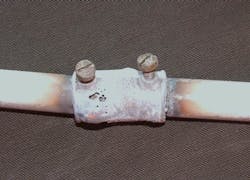
How well do you know the Code? Think you can spot violations the original installer either ignored or couldn't identify? Here's your chance to moonlight as an electrical inspector and second-guess someone else's work from the safety of your living room or office. It's your turn to identify the violation.
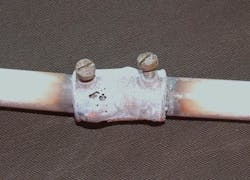
Hint: Someone's got a few screws loose
Find the Answer
An electrician discovered this pipe during a troubleshooting call. The overcurrent device protecting the circuit wires in this EMT never opened during a ground fault event. Luckily, someone noticed the pipe arcing/sparking and decided to call an electrician to check it out.
Section 250.118(4) permits EMT as an equipment grounding conductor, and 250.120(A) requires all connections, joints, and fittings be made tight using suitable tools. It appears the screws on this coupling were never tightened.
Section 250.4(A)(3) requires normally non-current-carrying conductive materials enclosing electrical conductors be connected together as well as to the electrical supply source in a manner to establish an effective ground-fault current path, which is defined in 250.2 as "an intentionally constructed, low-impedance electrically conductive path designed and intended to carry ground-fault current from the point of a ground fault on a wiring system to the electrical supply source and that facilitates the operation of the overcurrent protective device." The loose screws on the EMT coupling created a high-impedance path for fault current, which resulted in severe arcing at the coupling.
Imagine if this pipe was located in an area that was not visible. If left unchecked, the heat generated by the arcing could have easily started a fire.
> Try Another Quiz
About the Author

Russ LeBlanc
Owner
Russ started in the electrical trade as an apprentice in 1985. He worked his way up to become a Journeyman Electrician and then eventually became a Master Electrician and Licensed Construction Supervisor. In 1999 Russ become an Electrical Instructor for The Peterson School of Engineering in Massachusetts where he developed his passion for teaching, and quickly became Department Head of Electrical Instruction. Russ has taught thousands of apprentices, electricians, engineers, inspectors, and other electrical professionals during his career as an instructor. He continues to provide electrical professionals with Electrical Code seminars, Arc-Flash Awareness training seminars and educational material through his LeBlanc Consulting Services in North Reading, MA whose specialty is educating electricians. He has been an active member of the NFPA Electrical Section and has authored hundreds of National Electrical Code proposals and comments which have become Code rules to improve the safety for the electrical industry. Russ is also an IAEI certified Electrical Inspector.
Please visit www.russleblanc.net for more information.