• Subscribe
  • About Us
  • Magazine Issues
  • Newsletters
  • Advertise
  • Shop
Skip to Navigation Skip to Content
Electrical Construction & Maintenance (EC&M) Magazine
Register Log In
  • Forgot Your Password?
close
  • NEC
    • Code Basics
    • Q&A
    • Quizzes
    • Violations
    • What's Wrong Here?
  • Design
    • Computers & Software
    • Green Building
    • Lighting & Control
  • Ops & Maintenance
    • Energy Efficiency
    • Metering & Monitoring
    • Motors
    • Test & Measurement
  • Contractor
    • Business Management
    • Estimating
    • Low Voltage & Communications
    • Project Spotlight
  • Safety
    • Arc Flash
    • Fire & Security
    • Shock & Electrocution
  • Power Quality
    • Monitoring & Measurement
    • Sags & Swells & Interruptions
  • Training
    • Workplace Learning Center
    • Events
    • Webcasts
  • Basics
    • Bonding & Grounding
  • Products
    • Product of the Day
    • Product of the Year
Advertisement
Home > NEC > What's Wrong Here? > What’s Wrong Here? Hint: Get Back to Class
What’s Wrong Here? Hint: Get Back to Class

Jul. 19, 2012 Russ LeBlanc | Electrical Construction and Maintenance
    • EMAIL
  • Tweet
Comments 21

What is in this article?:

  • What’s Wrong Here? Hint: Get Back to Class
  • Find the Answer

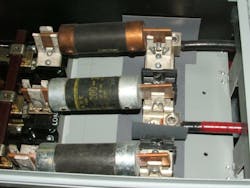
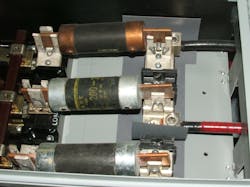
Can you identify the Code violation(s) in this photo?

Advertisement
« 
  • Prev
  • 1
  • 2
  • Print
  • reprints
  • Favorite
    • EMAIL
  • Tweet

Discuss this Article 21

Michael (not verified)
on Jul 19, 2012

mismatched fuses

  • reply
Paul Ternstrom (not verified)
on Jul 19, 2012

In addition to the fuse issue, the wiring from the switch does not appear to be 200A wiring (3/0 THHN)

  • reply
Francisco Cruz (not verified)
on Jul 19, 2012

" High Leg " conductor in a 240 volts three phase fuse disconnect shall be located at right terminal .

  • reply
Anonymous (not verified)
on Jul 19, 2012

That's incorrect. That's only in service rated meter sockets. Everywhere else; in panels, on breakers, in disconnect switches, they "high" leg is in the center position.

  • reply
Old Spark (not verified)
on Jul 20, 2012

High leg is also supposed to be phase taped orange not red.

  • reply
Richard Craver (not verified)
on Jul 19, 2012

The supply fuse clips are two small, i.e. the fuse tabs should fit inside the clips completely (securely).

  • reply
David Parent (not verified)
on Jul 19, 2012

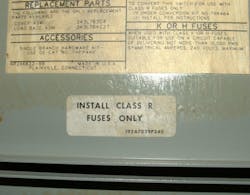
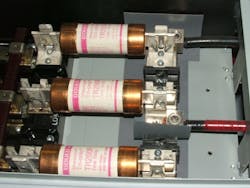
The fuses are the wrong type. They need to be type 'R' to accommodate the rejection pins in fuse clips designed for the class to which the fuse belongs.They are also lacking the proper markings.

  • reply
Anonymous (not verified)
on Jul 19, 2012

Looks like non rejection type fuse in rejection
type clip. Short circuit protection may be compromised

  • reply
Anonymous (not verified)
on Jul 19, 2012

Rejection type fuse holders with wrong class fuses installed. Likely called for current limiting fuses.

  • reply
Anonymous (not verified)
on Jul 19, 2012

fuse rejection feature in holder is defeated.

  • reply
Chazz (not verified)
on Jul 19, 2012

Fusible disconnect is designed with Class R rejection clips. Fuses installed are not Class R fuses.

  • reply
Anonymous (not verified)
on Jul 19, 2012

A moron not an electrician put the fuses in That's whats wrong!!

  • reply
Anonymous (not verified)
on Jul 19, 2012

The phase conductors are brought through separate knockouts.

  • reply
Anonymous (not verified)
on Jul 20, 2012

The Handy man did it. now start arresting non licensed side jobers

  • reply
Anonymous (not verified)
on Jun 15, 2013

you don't have to get 100% right to get licensed

  • reply
Anonymous (not verified)
on Jul 20, 2012

Wild phase is required to be in the "middle" for fuse and switch gear. Only on right hand side in a meter socket - (Three Phase Self Contained 200/320A)

  • reply
Old Spark (not verified)
on Jul 20, 2012

If this is delta with a high leg, the phase tape should be orange not red. This was a code change 20 years ago. Lots of things wrong here.

  • reply
Anonymous (not verified)
on Jul 21, 2012

not being able to see all three wires, phase rotation could be counter clock wise, wire markers could be blue - red - black instead of black - red - blue. but the main thing here is the wrong type of fuse.

  • reply
Russ LeBlanc (not verified)
on Jul 28, 2012

Thanks for getting some great discussions going!

  • reply
Dave Radford (not verified)
on Oct 25, 2012

Why do you all think this is a high leg, anyone think that it is a disconnect that they changed phasing on for motor rotation? Common people the fuses are the wrong type. Maybe wrong amperage too, the person who has done this must be a first year journeyman.

  • reply
Anonymous (not verified)
on Dec 8, 2012

Just read this, but congratulations, best answer

  • reply
Post new comment
Sign In or register to use your Electrical Construction & Maintenance (EC&M) Magazine ID
(optional)
Sponsored Links
Related Articles
  • What's Wrong Here? Hint: Installer Should Go Back to School 2
  • What's Wrong Here? Hint: It’s Getting a Little Warm in Here 2
  • What’s Wrong Here? Hint: If Two Is Company, and Three’s a Crowd — What’s 10? 2
  • What’s Wrong Here? Hint: It's What You Don't See 10
  • What’s Wrong Here? Hint: Window Display Lighting Doesn’t Quite Measure Up 1
Sponsored by
EC&M Learning Center
2011 Electrician Exam Preparation Book & Journeyman Simulated Exam
Printed in full color, the 2011Exam Prep book covers Theory, Code, and Calculations in great detail. Clear colorful graphics...
2011 Understanding NEC Requirement for Solar Photovoltaic Systems
Solar power is new to most in the electrical industry and this expanding and exciting industry has created many NEC...
Photovoltaics for Commerical and Utilities Power Generation
This book provides an in-depth review of the solar industry development, and present-day state of the art, emphasizing...
BROWSE ALL TITLES
Advertisement
Webinars
ON DEMAND: All You Ever Wanted to Know About GFCIs & AFCIs

Abstract:  In this webinar, Mike will not only explain the current NEC requirements for GFCIs and AFCIs, but he'll explain how they operate, what causes their premature failure, and when they won't provide the safety protection you might have thought they would.


Sponsored by:


ON DEMAND: Workplace Electrical Safety: Prevention before Protection


Abstract: This webinar will teach attendees the difference between risk and hazard, and how the choice of system grounding has a direct impact on reliability and safety.


Sponsored by:


MORE WEBINARS
Advertisement
EC&M TV
Jan. 7, 2011
video
Electrical Construction and Maintenance

Arlington non-metallic 8161 Series Boxes

Arlington’s non-metallic 8161 Series Boxes offer installation options for cameras and more, indoor or outdoor, for wet or dry locations...More
Showing 13-13 of 21 items
  • prev
  • 1
  • …
  • 12
  • 13
  • 14
  • …
  • 21
  • next


BROWSE ALL VIDEOS


equipmentone.com

Search 2.5+ million listings
prev next

Newsletter Signup

Sign-up to receive our free newsletters

Subscribe
Connect With Us
  • Twitter
  • Facebook
  • Linked In
  • RSS
Advertisement
Ecmweb.com
  • NEC
  • Design
  • Ops & Maintenance
  • Contractor
  • Safety
  • Power Quality
  • Training
  • Basics
  • Products
Site Features
  • Author Guidelines
  • RSS
  • Sitemap
  • Site Archive
  • Subscribe
  • View Mobile Site
EC&M Corporate
  • Privacy Statement
  • Terms of Use
  • About Us
  • Advertise
  • Contact Us
Follow Us
  • Twitter
  • Facebook
  • Linked In
  • RSS
Search ecmweb.com
Subscribe to the print magazine

PISCES

Related EC&M Sites
  • Electrical Wholesaling
  • Electrical Marketing
  • Transmission & Distribution World
Copyright © 2013 Penton

Sponsored Introduction Continue on to (or wait seconds) ×