What’s Wrong Here? Hint: Feel the Power
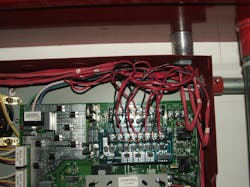
How well do you know the Code? Think you can spot violations the original installer either ignored or couldn't identify? Here's your chance to moonlight as an electrical inspector and second-guess someone else's work from the safety of your living room or office. It's your turn to identify the violation.
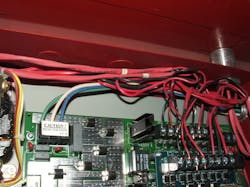
Hint: Can you feel the power?
Find the Answer
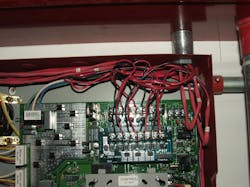
The blue and white wires in Photo 1 (above) are the 120V branch circuit wires feeding power to this fire alarm panel. The red cables are power-limited fire alarm circuit cables. According to 760.136(A), "Power-limited fire alarm circuit cables and conductors shall not be placed in any cable, cable tray, compartment, enclosure, manhole, outlet box, device box, raceway, or similar fitting with conductors of electric light, power, Class 1, non–power-limited fire alarm circuits, and medium-power network-powered broadband communications circuits unless permitted by 760.136(B) through (G)." According to 760.136(B) and (C), methods to permit both types of circuits in the same enclosure include keeping them separated by a barrier or by installing a raceway within the enclosure to keep the two types of circuits from contacting each other.
Photo 2 (above) clearly shows that there is no separation between the two types of circuits. The blue and white power wires are actually in contact with the fire alarm circuit conductors. This is a violation of Sec. 760.133(D). The power-limited conductors are permitted in the same enclosure with the power conductors, because both sets of conductors connect to the same fire alarm equipment; however there should be at least ¼ in. separation from the conductors and cables of power-limited fire alarm circuits and the branch circuit power wires.
> Try Another Quiz
About the Author

Russ LeBlanc
Owner
Russ started in the electrical trade as an apprentice in 1985. He worked his way up to become a Journeyman Electrician and then eventually became a Master Electrician and Licensed Construction Supervisor. In 1999 Russ become an Electrical Instructor for The Peterson School of Engineering in Massachusetts where he developed his passion for teaching, and quickly became Department Head of Electrical Instruction. Russ has taught thousands of apprentices, electricians, engineers, inspectors, and other electrical professionals during his career as an instructor. He continues to provide electrical professionals with Electrical Code seminars, Arc-Flash Awareness training seminars and educational material through his LeBlanc Consulting Services in North Reading, MA whose specialty is educating electricians. He has been an active member of the NFPA Electrical Section and has authored hundreds of National Electrical Code proposals and comments which have become Code rules to improve the safety for the electrical industry. Russ is also an IAEI certified Electrical Inspector.
Please visit www.russleblanc.net for more information.