Protecting Critical Loads with Commodity UPSs
The need for small commodity UPS systems has grown significantly in recent years because of the increase in telecommuting, home offices, and distributed computing in general. In fact, end-users can purchase commodity UPSs from retail outlets, mail order catalogs, or the Internet for as little as $30.
In light of this dramatic growth, Electrotek Concepts' E Source PQ Group (now disbanded), in cooperation with Power Standards Laboratory, conducted a testing project in the early 2000s to identify the most important application considerations and develop guidelines for using commodity UPS systems. As you'll see, the testing project provided some interesting results that are even more important today.
Testing objectives
With more than 100 suppliers of commodity UPS systems, those involved with the project decided it wasn't possible to test every one. Instead, they focused on testing a variety of units that encompassed different designs (See SIDEBAR No. 1: Configuration Categories below), prices, and characteristics. Eighteen units, with ratings from 300VA to 1kVA, were selected. The tests were designed to answer the following questions:
-
What are the different features and characteristics available in commodity UPS systems?
-
What is the duration of backup provided by the UPS during outages? Do cold temperatures affect the backup duration?
-
How does the UPS perform during overload conditions?
-
Can the UPS handle inrush characteristics, such as those associated with laser printers?
-
What is the voltage regulation provided by the UPS?
-
What are the harmonic distortion characteristics of the UPS?
-
Is the UPS sensitive to minor voltage disturbances, such as capacitor-switching transients? Does it provide any filtering for these disturbances?
-
Is the UPS sensitive to input voltage distortion? Does it provide any filtering to reduce the voltage distortion?
-
What is the UPS's response to voltage sags?
We won't go through the results for each of the 18 units tested here. Instead, we'll discuss the general results and important application issues, helping you to ask the right questions when you set out to purchase a commodity UPS.
Load characteristics
The first thing to decide is what size of UPS will best meet your needs. This depends on the characteristics of the load you want to protect. Typically, you'll be protecting office equipment, such as computers, monitors, printers, and fax machines. The project tested some of these devices to show their typical characteristics. The results are included in the Table (click here to see Table).
In this Table, you'll notice there's a big difference between the volt-ampere and watt requirements of the loads. Most of the UPS systems are rated in volt-amperes, so you have to be careful if you're looking at the watt rating and comparing it to loads that contain significant harmonic components in the current, which require additional derating. A reasonable rule of thumb is to add another 25% to the capacity for the harmonic requirements of the load.
One final important load characteristic is the short-term requirements for equipment such as laser printers. Manuals for most commodity UPS systems specify that end-users should not include laser printers on protected outputs because they can overload UPS systems.
Basic capabilities
All of the UPSs tested performed the basic function of providing backup during outages. Backup durations ranged from 5 minutes to 15 minutes.
At cold temperatures, most of the UPSs lost between 20% to 50% of their endurance. One unit actually demonstrated longer endurance. Another failed completely but recovered when it was brought back up to room temperature.
The testing project also found that some of the units were able to handle overloads. The maximum overload was 150% of rated capacity. Some units handled this, but most shut down at this level. Interestingly enough, the units that withstood this overload ranged widely in price (low to high) and configuration.
One thing most of the units could not handle was a momentary load increase. Tests simulated the impact of a laser printer printing and a motor starting while the unit was in backup mode. Most manuals clearly stated that the units were not designed to support these types of inrush currents. Sure enough, most didn't. Only two units supported the load increase, while the others required manual restarting. This supports the manufacturer recommendations not to power a laser printer or any load requiring motor starting through a UPS.
Output waveform characteristics
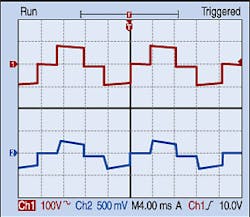
Commodity UPSs can display a wide range of output voltage waveforms. The most basic units provide a square wave or stepped wave output (Fig. 1). Obviously, this waveform contains significant harmonic distortion. However, most pieces of electronic equipment, such as computers, are relatively insensitive to this harmonic distortion and will operate fine with this waveform — especially for the short durations when the UPS supplies the load.
If you have loads that are sensitive to harmonic distortion, it's more important to buy a unit with sine wave output (Fig. 2). This is typical of online UPS systems because this voltage waveform is supplied to the load at all times, not just during backup for disturbances.
Voltage regulation
This characteristic can be an important factor in selecting the best UPS system for your application. The testing project found a wide variety of characteristics. Some units had no steady-state voltage regulation at all, while others maintained the output voltage within tight tolerances over a wide range of input voltages (e.g., ±3% output for input voltages ranging from -75% to +10% of nominal).
As for most electronic loads, voltage regulation may not be all that critical because the power supplies are essentially voltage regulators. However, voltage regulation can be important because it may prevent unnecessary UPS operations during minor variations in supply voltages. For instance, normal voltage variations associated with motor starting or other load variations could cause momentary voltage sags to less than 90% of nominal. If each of these events causes the UPS to switch to battery, loss of battery life can result. It's much better if the UPS can handle these events with voltage regulation from a ferroresonant transformer, which would extend the unit's life.
Voltage sags caused by faults on the utility supply system can have a wider range of characteristics. The project tested the UPS systems for response to voltage sags over the entire range of magnitudes and durations. For severe sags with minimum voltages less than 75%, the most common response was to switch to battery power for approximately 3 seconds and then reconnect to the source. For minor sags, some units handled the sag without switching to battery, while others switched to battery for any voltage sag where the minimum voltage was less than 90%.
Sensitivity to harmonics
We've talked about output voltage waveform characteristics, but how did the UPS systems respond to distorted input voltages? This is an important question because these units are often installed in facilities where a large percentage of electronic loads are subject to voltage distortions.
The testing project found significantly different response characteristics for varying levels of input voltage distortion. All of the units handled input voltage distortion up to 7% without any problem. However, when the voltage distortion exceeded this level, some of the units began to exhibit interesting characteristics. The more sensitive units treated the input voltage distortions as outages and switched to battery. When the battery discharged, some of the units switched off, leaving the loads without power until someone manually restarted or bypassed the unit.
If your site experiences significant voltage distortion, make sure your UPS can handle this without problems.
Capacitor-switching transients
UPS systems can interpret capacitor-switching transients as outages and switch to batteries (Fig. 3). Many customer UPS systems beep almost every morning when capacitor banks switch on the utility supply system. This can cause degradation of the battery because of frequent operation. It would be better if the UPS ignored this transient. Fortunately, many UPS units can be adjusted to reduce this sensitivity.
Drawing conclusions
The most significant finding of the testing project was that price is not necessarily an indicator of how a UPS will perform. While the less-expensive units had fewer features, they demonstrated an ability to adequately protect most office loads.
When you need to purchase a commodity UPS, use the questions noted in SIDEBAR No. 2: Tips for Buying Commodity UPSs to help make your decision. With the low prices of these small UPS systems, there's no reason to jeopardize the reliability of your critical office loads.
Editor's note: This piece originally appeared in the May 2002 issue of Power Quality Magazine. Due to increased interest in this topic, we have reproduced this article and updated it where needed. The original authors were Mark McGranaghan and Sandy Smith, both formerly with Electrotek Concepts, Knoxville, Tenn.
SIDEBAR No. 1: Configuration Categories
UPS systems are devices with batteries that provide backup/ride-through power when the utility supply is interrupted. These systems use rectifiers to charge the batteries from the utility supply and inverters to convert the batteries' DC outputs to AC. They also may have constant-voltage or tap-switching transformers, which can provide voltage regulation. In addition, they typically include surge suppressors to protect loads from transient overvoltages.
In general, UPS systems fall into one of three configuration categories:
-
Standby (offline) units basically switch from the utility supply to batteries when they sense voltage changes and typically do not offer steady-state voltage control;
-
Line-interactive units also switch from the utility supply to batteries when input voltages change, but typically use ferroresonant transformers to provide voltage control; and
- Online, where power is constantly supplied by the battery through an inverter, with the battery continuously recharged through a rectifier and a rectifier/inverter combination providing isolation between the source and load. The inverter can directly handle voltage control, as can a ferroresonant transformer (if included). The online design is typical of larger UPS systems but less common in the commodity UPS market (e.g., less than 1kVA).
SIDEBAR No. 2: Tips for Buying Commodity UPSs
There are multiple factors to consider when you want to purchase a small UPS to protect office equipment loads. Make sure you've answered the following questions before you write the check:
-
What rating do you need? Make sure you get enough capacity to handle the volt-ampere requirement of your load and allow a margin for the harmonic characteristics of the load.
-
Can you tell how the unit is operating? Look for indicators associated with battery charge, surge suppressor protection, and operating status.
-
Is there software for interfacing with your computer or server?
-
Is there voltage regulation to prevent unnecessary switching to battery for minor voltage variations?
-
Is the system sensitive to input voltage distortion or capacitor-switching transients? Is there an adjustment to change this sensitivity?
-
Do you need a sine wave output? Probably not, unless your protected loads include motors — or the unit is an online type.