But the reality is that 70E, last updated in 2009, is now a more ironclad and nuanced safety document. Those looking to it as one way to comply with OSHA worker safety rules will have more standards to meet and practices to follow, not to mention clearer guidelines on ensuring workplace electrical safety. Employers, workers, electrical contractors, trainers, and, to some extent, suppliers of electrical components and safety products will feel the effects of this latest round of revisions to different degrees.
While many again reflect new knowledge and a better understanding of risks and hazards, the vast majority of the revisions seem to buttress the view that safety comes down to just keeping an eye on the ball. By carefully developing and religiously following formal procedures — and creating a system of checks and balances to ensure they’re carried out — parties responsible for worker safety will be better positioned to head off potentially deadly mishaps.
The NFPA 70E Technical Committee on Electrical Safety in the Workplace, which developed the revisions approved by the National Fire Protection Association (NFPA), addressed that through a number of additions and clarifications of language that spell out employer responsibilities for making work environments as safe as possible. Let’s take a look at some of the most significant changes and how they will affect electrical professionals.
More robust training
The updated 70E now calls for worker training in new areas more often with a better paper trail confirming it’s been successfully carried out. Most notably, there’s a new provision that employers must verify that employees comply with 70E’s safety-related work practices on an annual basis through regular supervision or inspection, including the new arena of field work. Before, there was no set verification schedule. New content-specific requirements for training include the use of automatic external defibrillators and in methods of releasing victims from exposed energized parts.
At least every three years, employers must now audit the content of their electrical safety program to ensure compliance with 70E and provide documentation. Generally, if employees fail to demonstrate safe work practices, they must be retrained. In any event, retraining is now required at least every three years. In addition to keeping records of who received training and when, there’s a new provision for documenting the specific content of that training.
These and other related revisions to employer responsibilities for safety are an acknowledgement that vigilance, knowledge, and the workforce aren’t static conditions. Moreover, says technical committee member Dennis Neitzel, director emeritus of AVO Training Institute, Inc., Dallas, with OSHA focused more than ever on training and ensuring that it’s not just an afterthought, employers will want to make sure they’re able to demonstrate that employees are fully trained and qualified, capable, and safety conscious when working around electricity.
“OSHA does enforce documentation, and their attitude generally is that if it hasn’t been documented, it didn’t happen,” he says. “We didn’t make these changes for that reason only; our main objective was to find a way to make sure that these things get done through audits and retraining. The new requirements and time constraints will mean more paperwork, time, and investment, but standards change and revisions and updates need to be accounted for.”
Along the same lines, the new standard also now calls for host employers to have a formal meeting with contractors brought in to work on electrical equipment and systems. The aim, says Tom McCauley, president of Consolidated Consulting Corp., an electrical engineering consulting firm headquartered in Vero Beach, Fla., is to review workplace-specific hazards/risks and the game plan for addressing them.
“The contract between the facility and the contractor can be a tricky thing where each has their own procedures,” he says. “This documented meeting helps make sure that both are on the same page on what’s in the plant and what the dangerous parts of the plant might be. It’s an acknowledgement that accidents can happen when there’s not good communication.”
Clearly, enhanced vigilance of this sort will come at some sort of cost to responsible parties. Whether they’re able and willing to come into compliance on their own or seek outside assistance, employers and other service providers will likely find themselves spending more time building a bigger margin of worker safety into their operations. Ultimately, that amounts to a good investment, says Daryn Lewellyn, president of Lewellyn Technology, a Linton, Ind.-based electrical safety and maintenance training company that’s been ramping up staff and resources to answer calls for compliance assistance.
“I think addressing points like the three-year limit on retraining and the audit of the safety program will make people take more notice of the need to do things properly,” he says. “Hiring an outside consulting firm may be necessary with the need now to look at every aspect of electrical safety — from training and training documentation to plant and equipment walkthroughs to checking on PPE [personal protection equipment] inventories.”
A higher bar for energized work
While worker competence and training are vital to safety, their importance is a function of the base safety level of the working environment. The 2012 edition of 70E adds and refines language across the standard that adds more clarity to how workplaces can and should ensure that workers encounter the fewest conceivable risks and hazards.
To reiterate the preferable safety advantages of working in a de-energized environment, whenever possible, a revision at the beginning of Sec. 130.1 – Electrically Safe Working Conditions clarifies the necessity of first justifying the need for energized work. Added language here states energized conductors or circuit parts a worker might be exposed to should be made safe prior to work beginning if the worker is within the limited approach/arc flash boundary. The main effect of the new language, which does allow for exceptions if arc flash risks are gauged acceptably low via a hazard identification and risk assessment procedure, is to emphasize the need for up-front establishment of a full justification for working energized, Neitzel says.
“We put the wording in a certain order because of the need for establishing the foundation for energized electrical work and the basis for an energized work permit,” he says. “This offers the best protection for workers by giving employers every opportunity to de-energize before they even start talking about energized work. They have to prove that’s the only way to do it.”
While Neitzel says statistics do seem to suggest that less energized work is being done — due perhaps to greater awareness of 70E — the additional clarity in the 2012 edition could prompt more workplaces to look for opportunities to make de-energized work more feasible and commonplace.
Stemming shortcuts
In another bid to reiterate the importance of looking to Art. 130 for guidance on ensuring a safe workplace, the committee tweaked language that was leading to misinterpretations of the applicability and importance of the article’s specific protection requirements in different scenarios.
“One of the most significant changes is that while there are two general ways to do a hazard analysis — one by doing incident energy calculations and the other by using hazard/risk category tables — a lot of people think the tables are independent of the rest of the requirements of Art. 130,” says Palmer Hickman, director of code and safety training and curriculum development for the National Joint Apprenticeship and Training Committee (NJATC) and a member of the 70E technical committee. “The tables might appear to conflict with requirements outside the tables. New language makes clear that the tables don’t operate in a vacuum and are not independent of the rest of the requirements.”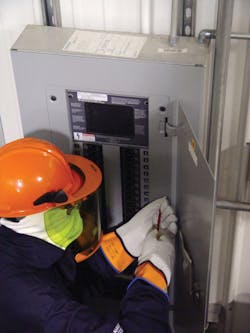
For example, guidelines in the text of Art. 130 on the use of an arc-rated balaclava indicate they’re required when the back of the head is within the arc-flash boundary, notes Hickman. There’s no such reference to the need for such protection for hazard/risk Category 1 when the back of the head is within the arc-flash boundary. “Too many folks who open up 70E and look at the tables for guidance wouldn’t get that,” he says. “You often need to look deeper than just the tables.”
Concern that greater reliance on quick and dirty HRC table misuse was unintentionally elevating risk also led to changes in how information is presented. Short circuit current, fault clearing time, and potential arc flash boundary information have been moved from table notes into the major equipment categories.
“That brings the information more to the forefront for people to see and hopefully pay attention to,” Neitzel says.
In a related change, information on arc flash warning labels is now more definitive in addressing what types of protection are needed for different types of work as well as potential exposures and how that is to be calculated.
“Someone can’t just go to the tables and take it at face value as to what’s going to be used,” Neitzel says. “You will have to have done a short circuit analysis and protective device coordination studies to know whether you can even use the tables. It needs to be proven and documented now — to validate the chosen PPE that is stated on the label.”
Bolstering PPE requirements
Generally, PPE got a much closer look from reviewers, and that resulted in a few notable changes in language addressing protective ratings and suitability in different exposure scenarios. In substituting references throughout 70E to “flame-resistant” (FR) PPE with “arc-rated,” reviewers sought to clarify the important difference between the two in the nature and level of protection. Transitioning to “arc-rated” terminology began with the 2009 revisions and was carried over to the 2012 edition, which included dropping (FR) completely to ensure employers were fully aware of the possible implications of selecting the wrong types of PPE.
“We’ve too often found that procurement officers tend to go with cheaper PPE that may be flame-resistant but has no arc rating,” Neitzel says. “In the 2012 revisions, we eliminated the term flame-resistant (FR) completely so there wouldn’t be any confusion. We want to ensure that workers are adequately protected with PPE made from fabrics that protect against both incident energy and the flash-flame hazards.”
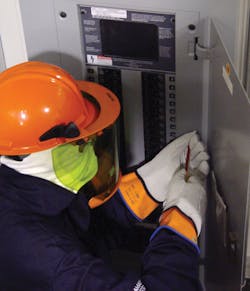
The 2012 revisions also seek to increase the margin of safety afforded by PPE in some scenarios. Of particular note, a requirement for hearing protection (ear canal inserts) within the arc flash boundary has been spelled out, and a balaclava is now required for Category 2 tasks defined in the HRC tables, a result of the removal of the distinct 2* category that required a balaclava as a supplement to a hard hat and face shield. Larry Ayer, vice president of Biz Com Electric, Cincinnati, and a technical committee member, rates that change as significant in that it’s evidence of 70E’s steadily greater recognition of the need for proper and adequate PPE.
“The balaclava now applies in more instances, even for less hazardous tasks,” he says. “The committee was concerned that Category 2 PPE requirements left the back of the head exposed. So a contractor can’t just put on a face shield in those situations. As a contractor, the way I see it is the more protection, the better.”
PPE, combined with proper training, goes a long way to minimizing risk and mitigating hazards workers may encounter, and the new 70E clearly addresses that in a more robust fashion. But arming workplaces and workers with clear and reliable information on risks and hazards posed by working on electrical equipment is an essential first step. The 2012 revisions seek to address this goal with not only more definitive equipment labeling requirements but also clearer guidelines on the importance of properly maintaining and monitoring equipment that workers routinely encounter.
Clearer, more accurate labeling
Thus, a revised requirement in Art. 130 spells out more clearly how switchboards, panelboards, control panels, and like equipment must be labeled with critical information needed to gauge and mitigate potential risks and hazards. Now, a label must include nominal system voltage and the arc flash boundary, as well as at least one of the following: available incident energy level, minimum arc rating of clothing, required level of PPE, or highest hazard/risk category for the equipment.
“Many of the arc flash equipment labels installed today are incorrect because they include both an incident energy level and an HRC level, which can be confusing since only one method should be used,” Ayer says.
According to McCauley, the new, more definitive labeling requirement reflects the reality that accurate risk and hazard assessment on different equipment in different settings can be challenging. That’s a problem compounded by 70E’s historic allowance of numerous calculation methods that would benefit from greater clarity and specificity.
“In the past, the practice was to put incident energy information on the label, but the reality is that can change all the time depending on the configuration of a plant’s systems,” he says. “Something may be classified as, say, a Category 3, but there’s a range on that.”
Because accurate and reliable labels depend on precise engineering assessments of equipment, which over time can fall into disrepair that might render original calculations inaccurate, the 2012 edition codifies the importance of maintenance. Specifically, new language in Art. 205 states that to minimize the risk of failure and exposure to hazards, electrical equipment must be maintained in accordance with manufacturers’ instructions or industry consensus standards.
Committee member Ron Widup, president of Shermco Industries, a Dallas electrical power system testing company, says the new, pointed reference to a maintenance standard is evidence of growing recognition in the industry that worker safety is a function of proper maintenance.
“Calculation of incident energy exposure and specification of the proper PPE is premised on an engineering analysis either IEEE 1584 or 70E guidance, and it’s all based on the assumption that the relay, fuse, or circuit breaker has been installed and maintained properly,” Widup says. “But if an overcurrent protective device or panel hasn’t been tested in years, you have to ask yourself what the chance of the arc flash hazard analysis label on the equipment being accurate is. Over the next few cycles of 70E revisions, I think we’re going to see more focus on the maintenance aspect because it’s key to the validation of the engineering assessments designed to protect workers.”
Zind is a freelance writer based in Lee’s Summit, Mo. He can be reached at [email protected].
About the Author
Tom Zind
Freelance Writer
Zind is a freelance writer based in Lee’s Summit, Mo. He can be reached at [email protected].