The Basics of Overcurrent Protection
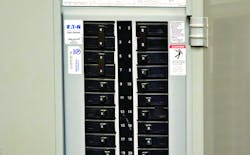
Overcurrent protection of conductors is an idea so simple that it is almost self-evident. Excessive current in a conductor results in rapid temperature rise, which damages insulation and creates enough heat to ignite nearby combustible material. Therefore, if you limit the current to a manageable level, you’ll protect the conductor and any materials nearby.
You can achieve this in one of two ways:
1) Insert a short segment of material of lesser ampacity (e.g., a fuse) in the circuit path, which would melt and open the circuit path before more widespread damage could occur, or
2) Incorporate a mechanical device into the circuit (e.g., a circuit breaker) that would perform the same protective function, but that could be reset any number of times rather than being replaced.
Fuses provide perfectly competent overcurrent protection. However, in residential and other low-power applications, they are considered obsolete, though still Code-compliant. Besides being resettable, a circuit breaker provides a clear visible indicator when it has switched off after detecting a fault. In addition, these types of panelboards are easier to wire and repair.
O&M problems and solutions
Plug fuses that have blown may often be considered to be out of service, but this is not always the case. Old fuse boxes may have out-of-date, missing, or illegible directories, so it’s necessary to find the open fuse. Many times, old fuses are stuck in place, so it is difficult to unscrew them. Rather than removing each fuse and checking it with an ohmmeter, it is better to measure the voltage across each fuse. A good fuse will always measure 0V, whereas an open fuse will read some voltage, because the load side is hot. The output terminal will have a ground potential through the load, if it is connected. A neon tester or solenoid voltmeter works well for this operation.
Sometimes, a branch circuit will exhibit intermittent operation, causing flickering lights. If you gently move the breaker handle from side to side, the flicker will respond. You may hear a frying sound or see light coming from behind the breaker. This means the contacts — where they draw current from the bus bar — have become corroded and are making a less-than-perfect joint. Once this process begins, it will accelerate as less good metal remains available to perform its function.
A missing panel cover can also create problems. One of the functions of the cover is to hold the breakers firmly in place.
If the damage at a single-pole breaker is severe, most electricians replace the box. This is actually not necessary, because it is possible to replace the offending bus bar at a fraction of the cost, using a bus bar kit available from the manufacturer. Be sure to get the catalog number off the box, due to the number of variations.
Breakers should be exercised (turned off and on) periodically. Trade practice is for breakers to be exercised once per year, regardless of size. Where there is no excessive dust or humidity, this interval may be extended to once every three years, but the procedure is so easy that you might as well do it once a year. This is particularly true in the larger sizes, and it should be part of the preventive maintenance program in any large facility. If properly maintained, breakers last a long time. However, some workers intentionally shunt a branch circuit in order to trip the breaker. This is a very poor maintenance practice, because it stresses the contacts and shortens the life of the breaker.
If large aluminum conductors are terminated at a circuit breaker, then the lugs need to be retorqued periodically. A loose connection where heavy current is present will inevitably heat up.
Follow the Code
Needless to say, the NEC covers all aspects of overcurrent protection where electrical safety is an issue (Art. 240, Overcurrent Protection). The topic is straightforward and easy to understand, but it is essential that design and installation work be done correctly if the protection is to be meaningful. A close reading of the Code and adherence to its mandates regarding overcurrentprotection may not result in a totally efficient installation — or one that will have sufficient capacity for future usage — but we may be assured that it will be free of hazards to persons and property.
Article 240 begins by specifying that equipment is to be protected in accordance with the applicable Code article. There follows a table that lists 35 types of equipment in alphabetical order — ranging from air-conditioning and refrigerating to X-ray equipment — and includes article references. But the next section, Protection of Conductors, is really the heart of Art. 240. It specifies that conductors, other than flexible cords, flexible cables, and fixture wires (treated later), are to be protected against overcurrent in accordance with their ampacities specified in Sec. 310.15. There are, however, several paragraphs that amend this general principle:
-
Conductor overload protection is not required if the interruption of the circuit would introduce a hazard. An example is a crane with an electromagnet used to lift steel. Loss of power could endanger workers below. Another example is a fire pump, which should be allowed to run even as it is being damaged by overload. The idea here is that the fire-fighting function outweighs the value of the pump. Of course, cooling equipment in a nuclear reactor cannot be allowed to cutout due to overload. Notice, however, that only overload protection is specified. The conductors should still be provided with ground fault and short circuit protection. These events would interrupt power to the equipment anyway.
- If the overcurrent device is rated 800A or less, the next higher standard overcurrent protection may be used, provided the branch circuit protected by the conductors does not supply more than one receptacle for cord- and plug-connected loads.
- Small conductors have requirements. These involve listing requirements for fuses and circuit breakers as well as special treatment for continuous loads.
- Tap conductors are permitted, in certain limited instances, to be smaller than the conductors that supply them. This is a little bit counter-intuitive, because the tap wires are being fused at a higher level than their ampacity. Wouldn’t these wires overheat? The answer is that any temperature rise would not exceed acceptable levels due to limits placed on size reduction, coordinated with additional protection, such as being enclosed in raceway. Details are provided in Part II, Location.
- Transformer secondary conductors, under certain circumstances, may be considered adequately covered by the primary overcurrent protection. This is because a rise in current flow in the secondary will, because of electromagnetic induction and based on the turns ratio, result in a rise in current in the primary. It is essential to remember that such overcurrent protection is not to exceed the value determined by multiplying the secondary conductor ampacity by the secondary-to-primary transformer voltage ratio. Primary overcurrent protection is valid for secondary conductors only for a transformer with a 2-wire primary and 2-wire secondary, or for a 3-phase, delta-delta-connected transformer with a 3-wire, single-voltage secondary.
A subsequent section provides that fuses and circuit breakers may be connected in parallel only if factory assembled and listed as a unit.
There’s another requirement that, if overlooked, will require a massive amount of rework to correct. Overcurrent devices are not to be located in the vicinity of easily ignitable material, such as in clothes closets. They may not be installed in bathrooms of building units, dormitories, guest rooms, or guest suites. (In other occupancies, such as manufacturing facilities, they may be installed in bathrooms. They are not to be located over steps of a stairway in any occupancy.)
We have all seen overcurrent devices, such as cartridge fuses, that are closely integrated with a disconnecting means, such as a safety switch with an operating lever on the outside of the enclosure. But do you know the underlying mandates? Fuses in circuits over 150V to ground and cartridge fuses of any voltage, if accessible to unqualified persons, are to be provided with a disconnecting means on the supply side.
The Code discusses is some detail plug fuses, fuseholders, and adapters. Type S fuses are used where there is evidence of tampering in the past. These fuses are not interchangeable with lower ampere devices, and are designed so that they cannot be used in any fuseholder other than a Type S fuseholder or a fuseholder with a Type S adapter inserted. Type S adapters, once inserted in a fuseholder, cannot be removed. They are designed so that tampering or shunting would be difficult.
Part VII of Art. 240 shifts the focus from fuses to circuit breakers. There are several general requirements you should be aware of. All circuit breakers are to be trip free, meaning that if you fasten the handle in the ON position, the breaker will still trip when current reaches the critical level. There are devices that lock a breaker in the ON position so that power to critical electronic equipment will not be shut off without removing the device, but the overcurrent protection remains in place.
All circuit breakers must be capable of being opened and closed by manual operation. They must clearly indicate whether OFF or ON. If mounted vertically, the up position of the handle must be the ON position of the breaker.
Circuit breakers are to be non-tamperable, meaning that the trip point and time delay cannot be altered without dismantling the device or breaking the seal.
Circuit breakers are to be marked with amperage. If rated 100A or less and 600V or less, the ampere rating is to appear on handles or escutcheon areas. If the interrupting rating is other than 5,000A, that rating is to be marked on the breaker. The marked voltage rating is to be not less than the nominal system voltage.
A series-rated system involves a combination of circuit breakers or fuses and circuit breakers. If there is an increase in available fault current due to utility or customer-owned transformer or line upgrades, it may not be necessary to do a facility-wide replacement of all vulnerable downstream equipment. Instead, an engineering solution is implemented whereby it is assured that downstream breakers that are part of a series combination remain passive during the interruption period of the line-side fully rated current-limiting device. Needless to say, it is important that such measures function as expected. They should be designed by individuals fully knowledgeable in the area.
Herres is a licensed master electrician in Stewartstown, N.H. He can be reached at: [email protected].
About the Author
David Herres
Licensed Master Electrician
David Herres is a licensed master electrician in Stewartstown, N.H. He can be reached at [email protected].