Exterior Egress Lighting Requirements
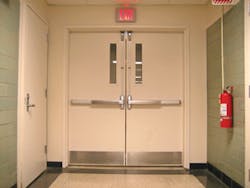
When it comes to egress lighting requirements, there is conflicting verbiage between the Life Safety Code (NFPA 101), the Uniform Building Code (UBC), and the International Building Code (IBC). This conflict can lead to varying interpretations of egress lighting requirements from jurisdiction to jurisdiction for both interior and exterior areas of commercial buildings.
I witnessed this discrepancy firsthand on the design of a recent project, where the code official interpreted the requirements for exterior egress lighting in a manner that required significantly higher levels of lighting than were dictated by NFPA 101. This increased lighting level was based on the code official's interpretation of the UBC.
Given this situation, it's important for the electrical engineer and/or lighting designer to determine the jurisdiction's interpretation of this requirement for egress lighting during the design process. Let's take a closer look at some of the differences in exterior lighting requirements to help clear up confusion.
Straight from the code
A good place to start is with a review of the requirements outlined for egress lighting in each of these three important codes.
Life Safety Code. Section 7.8.1.3 of NFPA 101 states, “The floors and other walking surfaces within an exit and within portions of the exit access and exit discharge designated in 7.8.1.1 shall be illuminated to values of at least 1 footcandle measured at the floor.”
Section 7.9.2.1, “Performance of Systems,” dictates the following: “Emergency illumination shall be provided for a period of 1½ hours in the event of failure of normal lighting. Emergency lighting facilities shall be arranged to provide initial illumination that is at least an average of 1 footcandle and a minimum at any point of 0.1 footcandle measured along the path of egress at floor level. Illumination levels may decline to 0.6 footcandles average and a minimum at any point of 0.06 footcandles at the end of the emergency illumination lighting time duration. A maximum to minimum illumination uniformity ratio of 40-to-1 shall not be exceeded.”
Uniform Building Code. Section 1003.2.9.1 of the UBC states, “Any time a building is occupied, the means of egress shall be illuminated at an intensity of not less than 1 footcandle at floor level.”
International Building Code. Section 1006.2, Illumination Level, of the IBC states, “The means of egress illumination level shall not be less than 1 footcandle at the floor level.”
Section 1006.4, Performance of Systems, states: “Emergency lighting facilities shall be arranged to provide initial illumination that is at least an average of 1 footcandle and a minimum of any point of 0.1 footcandles measured along the path of egress at floor level.”
It's all in the interpretation
Historically, there has been a conflict between the Life Safety Code and the UBC. The Performance of Systems section of NFPA 101 clearly defines that the average light level needs to be 1 footcandle, and the minimum is required to be 0.1-footcandle. Because the UBC does not have a Performance of Systems section, it can lead some authority having jurisdictions (AHJs) to require a minimum of 1 footcandle in your design.
On the other hand, in jurisdictions that enforce the IBC, this conflict and confusion is less prevalent. Why? The 2003 version of the IBC brought more clarity to this issue by adding a paragraph on the performance of the egress lighting system, which is the same as listed in NFPA 101. In other words, the IBC requirements for egress lighting are the same as those in NFPA 101.
In looking at the wording of Sec. 1006.4 of the IBC, we can see this section is almost identical to the requirements set forth in the UBC. As a standalone paragraph, the design would dictate a minimum of 1 footcandle — the same as noted in the UBC. The IBC is widely accepted in many states and features the same requirements for egress lighting as noted in the Life Safety Code.
Other design criteria
The steps taken by those in charge of overseeing and updating NFPA 101 and the IBC become more critical when comparing egress lighting requirements with Illuminating Engineering Society (IES)-recommended light levels for exterior areas of commercial buildings. The IES recommended lighting levels for wal-ways and bikeways is shown in Table 1. More specifically, data for an example of a pedestrian entrance area is shown in Table 2. The average footcandle of this example, 3.7, far exceeds the IES requirement of 0.9 footcandle, and the max/min value is less than 40-to-1. However, the minimum footcandle level falls short of 1 footcandle.
As you can see in this IES Table, all required light levels for exterior areas are less than an average of 1 footcandle. It has been my experience that if you were to follow the UBC requirement of a minimum of 1 footcandle, the average footcandle would be about 3 to 5. In this case, the required egress lighting levels would greatly exceed the IES requirements for normal exterior lighting.
Additionally, this high level of lighting is counter to energy-efficiency initiatives and night sky ordinances adopted by many communities. The Washington State Energy Code, for instance, states the lighting power allowance for covered parking, open parking, and outdoor areas that are illuminated shall be 0.2 watts per square foot.
In addition, other design criteria, such as LEED certification, limits the footcandle levels on the exterior of a commercial building. One of the credits required for LEED certification (i.e., light pollution reduction) requires the light level in the exterior of the building to be at or below the levels recommended by the IES-recommended practice manual for exterior environments.
Additional outdoor lighting requirements
Section 1003.2.2.24, Outdoor Areas, of the UBC states: “The occupant load of yards, patios, courts, and similar outdoor areas shall be assigned by the building official in accordance with their anticipated use. Such outdoor areas accessible to and usable by the building occupants shall be provided with a means of egress as required by this chapter.” This portion of the UBC indicates that some outdoor areas, as indicated by the AHJ, would also have to comply with egress lighting requirements of Chapter 10, as noted above.
One noteworthy portion of the IBC that differs from the UBC is Sec. 1006, Means of Egress Illumination. More specifically, 1006.3, Illumination Emergency Power, states, “The power supply for means of egress illumination shall normally be provided by the premise's electrical supply. In the event of power supply failure, an emergency electrical system shall automatically illuminate the following areas:
-
Exit access corridors, passageways, and aisles in rooms and spaces, which require two or more means of egress.
-
Exit access corridors and exit stairways located in buildings required to have two or more exits.
-
Exterior egress components at other than the level of exit discharge until exit discharge is accomplished for buildings required to have two or more exits.
-
Interior exit discharge elements, as permitted in Section 1023.1, in buildings required to have two or more exits.
-
The portion of the exterior exit discharge immediately adjacent to the exit discharge doorway in buildings required to have two or more exits.
*Exit Discharge is defined as the portion of the means of egress system between the termination of the exit and a public way.”
Item number five can greatly increase the level of exterior lighting required for the emergency egress system. The public right-of-way can potentially be a considerable distance from the exit doorway.
In summary, it's the responsibility of the design engineer or lighting designer to coordinate with all local jurisdictional requirements during the design process. Without a clear understanding of the interpretation of the required light levels for exterior egress by the AHJ, some significant problems could arise at the end of the construction phase. Additionally, egress light levels need to fall within prescribed energy codes and other design criteria adopted in the project area.
Lane is a registered professional engineer, RCDD/NTS specialist, TPM, LC, LEED A.P. and principal of Lane Coburn & Associates, LLC, an electrical engineering and consulting firm in Woodinville, Wash.