All electrical systems are susceptible to short circuits and the abnormal current levels they create. These currents can produce considerable thermal and mechanical stresses in electrical distribution equipment. Therefore, it's important to protect personnel and equipment by calculating short-circuit currents during system upgrade and design. Because these calculations are life-safety related, they're mandated by 110.9 of the NEC, which states:
“Equipment intended to interrupt current at fault levels shall have an interrupting rating sufficient for the nominal circuit voltage and the current that is available at the line terminals of the equipment. Equipment intended to interrupt current at other than fault levels shall have an interrupting rating at nominal circuit voltage sufficient for the current that must be interrupted.”
When you apply these requirements to a circuit breaker, you must calculate the maximum 3-phase fault current the breaker will be required to interrupt. This current can be defined as the short-circuit current available at the terminals of the protective device.
You can assume that 3-phase short circuits are “bolted,” or have no impedance. In addition, a 3-phase short circuit can be considered a balanced load, which means you can use a single-phase circuit to analyze one of the phases and the neutral.
Distribution equipment, such as circuit breakers, fuses, switchgear, and MCCs, have interrupting or withstand ratings defined as the maximum rms values of symmetrical current. A circuit breaker can't interrupt a circuit at the instant of inception of a short. Instead, due to the relay time delay and breaker contact parting time, it will interrupt the current after a period of five to eight cycles, by which time the DC component will have decayed to nearly zero and the fault will be virtually symmetrical.
Closing a breaker against an existing fault makes it possible to intercept the peak of the asymmetrical short-circuit current, which is greater than the rms value of the symmetrical current. For this reason, equipment is also tested at a particular test X/R ratio value typical to a particular electrical apparatus, such as switchgear, switchboards, or circuit breakers, and is designed and rated to withstand and/or close and latch the peak asymmetrical current described above.
Fault analysis is required to calculate and compare symmetrical and asymmetrical current values in order to select a protective device to adequately protect a piece of electrical distribution equipment.
Methods of calculation
Rather than using a theoretical approach to determine short-circuit currents, published standards offer methods to compute a symmetrical steady state solution to which you can apply a multiplier in order to obtain the peak value of an asymmetrical current. The result is precise enough to fall within an acceptable tolerance to meet NEC requirements.
The classical approach and the method defined by ANSI/IEEE are two such industry-accepted methods for calculating short circuits. Both methods assume that the fault impedance is zero (bolted short circuit) and the pre-fault voltage is constant during the evolution of the fault. In actuality, the fault has its own impedance, and the voltage drop, due to the short-circuit current, lowers the driving voltage.
The classical approach is used to calculate the Thevenin equivalent impedance as “seen” by the system at the point of the fault. Thevenin impedance is defined as the impedance seen at any point in a circuit once all the voltage generators have been short circuited and all the current generators have been opened. Transformer and utility impedances and rotating machine subtransient reactances describe all possible contributions to a short circuit. Once we have calculated the symmetrical and peak duties, we can determine the required rating of the protective device by direct comparison to manufacturer equipment ratings.
The IEEE standard permits the exclusion of all 3-phase induction motors below 50 hp and all single-phase motors. Hence, no reactance adjustment is needed for these motors. The Chart at left clarifies the ANSI/IEEE procedure.
Classical calculation
Begin by converting all impedances to “per unit” values. Per unit base values and formulae used are as follows:
Sbase =100MVA
Vbase =26.4 kV
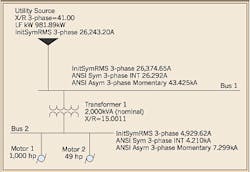
Let's run through an example calculation to make this discussion a little more tangible. Refer to the one-line diagram in the Figure below with the following input data:
- Utility: 26.4kV, 1,200MVA, X/R=41
- Transformer (T1): 2MVA, 26.4/4.16kV, DY-G, Z=7%, X/R515
- Motor 1 (M1): Induction, 4.16kV, 1,000 hp, PF=0.8, efficiency50.8, X"d= 0.16 pu, X/R=28
- Motor 2 (M2): Induction, 4.16kV, 49 hp, PF=0.8, efficiency=0.8, X"d=0.17 pu, X/R=10
Now it's possible to calculate the equivalent Thevenin impedance for a fault at Bus 2 by combining the per unit X and R values to obtain the relative impedances.
ZFault=(Zutility+ZT1)||ZMotor1||ZMotor2=(0.0021+j0.083+0.005+j0.07)||(0.49+j13.8)||(29.8+j298)=0.166+j2.817 pu=2.823ej86.6
We may now calculate the short-circuit current rms at Bus 2:
The peak duty the breaker is required to close and latch may be evaluated using the following formula, which constitutes a multiplier to the rms current, which was calculated above:
Use Table 1, page 1 in ANSI C37.06-1997 Preferred Ratings and Related Required Capabilities to rate new switchgear. It's useful in comparing calculated duty (4,916A and 12,692A) and standard ratings. The Table includes sample values extracted from the ANSI table.
These are the short-circuit current ratings required for our switchgear duty corresponding to a continuous current, for example, 1,200A. No further steps have to be taken, as the table itself, by comparison, provides the required specifications for the equipment to be installed.
ANSI/IEEE calculation
The ANSI/IEEE calculation method is based on the same per unit quantities as calculated before. However, it differs from the classical method because it makes it possible to study two separate circuits derived from the original one: one resistive only and one reactive only. This will be carried out for both momentary and interrupting network fault impedances.
For each network, Thevenin equivalent resistance and Thevenin equivalent reactance will then be combined in order to obtain the equivalent Thevenin impedance. This is the significant difference between the ANSI/IEEE procedure and the classical calculation method.
As mentioned before, the momentary network fault impedance is based on the subtransient reactances of the rotating machines, which allows for the calculation of the first-cycle peak fault duty. The total fault resistance and reactance values will be calculated separately, following the same formula as the ZFault equation in the classical calculation section, except the Zs must be replaced with the Rs and Xs.
Then they'll be combined as total fault impedance ZFault, which will yield ISC3-phase and IPeak according to the formulas.
The interrupting network fault impedance is based on individual equipment transient reactances. In the previous example, only the reactance of Motor 1 needs to be adjusted. It's acceptable to neglect Motor 2 at medium voltage levels. The resistances of the network, in fact, don't vary with respect to time. ANSI C37.010-1999 identifies the adjustment factor as 1.5.
In this case, the total fault resistance and fault reactance (with adjustments) will be calculated separately as already seen.
ISC3-phase, symmetrical duty is calculated as it was in the classical method. However, it's typically characterized by a smaller magnitude because the Zfault “interrupting” current is larger than the one in the momentary network calculation.
ISC3-phase is essential because a multiplier factor is applied to this quantity for comparison to the breaker interrupting rating.
This multiplier will account for:
- The additive contribution of the DC current component, which might still be “alive” after the time of contact parting.
- The eventual subtractive contribution of the AC current decay, due to the evolution of the reactances toward larger values. This effect is possible when the generation of power is local.
The multipliers, in function of time of contact parting and of the ratio X/R at the point of fault, are described in curves starting from figure A-8, page 60, C37.010-1999 (Figure above).
Once ISC3-phase has been multiplied by this factor (between 1 and 1.25), you have the minimum rating of your equipment. As in the classical method, you can also use Table 1, page 1 in ANSI C37.06-1997 to determine a standard rating.
Which method is better?
Both methods basically provide the same results. There are no theoretical reasons to prefer one to the other, only practical reasons. The ANSI/IEEE approach is the evolution of a method conceived in the '70s in the United States, when no computer-assisted calculations were available. ANSI/IEEE C37.010-1999 can only be used at medium or high voltages and only at 60 Hz. Calculation programs have been developed to determine fault currents that apply the multiplier factors called for in this standard. In fact, some clients may ask for the application of this calculation methodology by contract. Manufacturers may also recall the ANSI/IEEE standard in their catalogues. The classical method is used mainly in low-voltage studies and can also be applied at 50 Hz. It's a well-known procedure because it's a common topic in every “power system” college course.
Mitolo is an associate electrical engineer at Chu & Gassman Consulting Engineers in Middlesex, N.J.