Motor Calculations Part 1: Motors and Branch-Circuit Conductors
Thank you for visiting one of our most popular classic articles. If you’d like to see updated information on this topic, please check out this recently published article, Motor Calculations — Part 1. |
Based on the 2002 National Electrical Code.
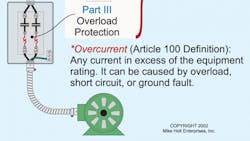
The best method for providing overcurrent protection for most circuits is to use a circuit breaker that combines overcurrent protection with short-circuit and ground-fault protection. However, this isn't usually the best choice for motors. With rare exceptions, the best method for providing overcurrent protection in these cases is to separate the overload protection devices from the short-circuit and ground-fault protection devices (Fig. 1).
Motor overload protection devices like heaters protect the motor, the motor control equipment, and the branch-circuit conductors from motor overload and the resultant excessive heating (430.31). They don't provide protection against short-circuits or ground-fault currents. That's the job of the branch and feeder breakers, which don't provide motor overload protection. This arrangement makes motor calculations different from those used for other types of loads. Let's look at how to apply Art. 430, starting at the motor.
Overload protection
Motor overload devices are often integrated into the motor starter. But you can use a separate overload device like a dual-element fuse, which is usually located near the motor starter, not the supply breaker.

Motors rated more than 1 hp without integral thermal protection and motors rated 1 hp or less that are automatically started [430.32(C)] must have an overload device sized per the motor nameplate current rating [430.6(A)]. You must size the overload devices no larger than the requirements of 430.32. Motors with a nameplate service factor (SF) rating of 1.15 or more must have an overload protection device sized no more than 125% of the motor nameplate current rating.
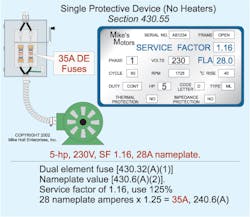
Let's look at Fig. 2 and work through a sample calculation.
Example No. 1: Suppose you use a dual-element fuse for overload protection. What size fuse do you need for a 5-hp, 230V, single-phase motor with a service factor of 1.16 if the motor nameplate current rating is 28A?
(a) 25A
(c) 35A
(b) 30A
(d) 40A
The overload protection shall be sized according to the motor nameplate current rating [430.6(A), 430.32(A)(1), and 430.55].
You also have to consider another factor: nameplate temperature rise. For motors with a nameplate temperature rise rating not over 40°C, size the overload protection device no more than 125% of the motor nameplate current rating. Thus, 28A×1.25=35A [240.6(A)]

Example No. 2: Again, suppose you're using a dual-element fuse for the overload protection. What size fuse do you need for a 50-hp, 460V, 3-phase motor that has a temperature rise of 39°C and motor nameplate current rating of 60A (FLA)?
(a) 40A
(c) 60A
(b) 50A
(d) 70A
The overload protection is sized per the motor nameplate current rating, not the motor full load current (FLC) rating. Thus, 60A×1.25=75A. Overload protection shall not exceed 75A, so you need to use a 70A dual-element fuse [240.6(A) and 430.32(A)(1)].
Motors that don't have a service factor rating of 1.15 or higher or a temperature rise rating of 40°C and less must have an overload protection device sized at not more than 115% of the motor nameplate ampere rating (430.37).

Sizing branch-circuit conductors
Branch-circuit conductors that serve a single motor must have an ampacity of not less than 125% of the motor's FLC as listed in Tables 430.147 through 430.150 [430.6(A)]. You must select the conductor size from Table 310.16 according to the terminal temperature rating (60°C or 75°C) of the equipment [110.14(C)]. Let's reinforce this concept by working through a sample calculation. Refer to Fig. 4.
Example No. 3: What size THHN conductor do you need for a 2-hp, 230V, single-phase motor?
(a) 14 AWG
(c) 10 AWG
(b) 12 AWG
(d) 8 AWG
Let's walk through the solution:
Step 1: Conductor sized no less than 125% of motor FLC
Step 2: Table 430.148 shows the FLC of 2-hp, 230V, single-phase as 12A
Step 3: 12A × 1.25 = 15A
Step 4: Per Table 310.16, you need to use 14 AWG THHN rated 20A at 60°C
The minimum size conductor the NEC permits for building wiring is 14 AWG [310.5]. However, local codes and many industrial facilities have requirements that 12 AWG be used as the smallest branch-circuit wire. So in this example you might need to use 12 AWG instead of 14 AWG.

Branch-circuit short-circuit and ground-fault protection devices protect the motor, motor control apparatus, and conductors against short circuits or ground faults. They don't protect against an overload (430.51) (Fig. 5).
The short-circuit and ground-fault protection device required for motor circuits isn't the type required for personnel (210.8), feeders (215.9 and 240.13), services (230.95), or temporary wiring for receptacles (527.6).
Per 430.52(C), you must size the short-circuit and ground-fault protection for the motor branch circuit — except those that serve torque motors — so they're no greater than the percentages listed in Table 430.52.
When the short-circuit and ground-fault protection device value that you find in Table 430.52 doesn't correspond to the standard rating or setting of overcurrent protection devices as listed in 240.6(A), use the next higher protection device size [430.52(C)(1) Ex. 1].
Did that statement stop you? Does it strike you as incorrect? That's a common response, but remember, motors are different than other system components. Motor overload protection devices, such as heaters and fuses, protect the motor and other items from overload. The short-circuit and ground-fault protection doesn't need to perform this function. Therefore, oversizing won't compromise protection. Undersizing will prevent the motor from starting.
Use the following two-step process to determine what percentage from Table 430.52 you should use to size the motor branch-circuit short-circuit ground-fault protection device.
Step 1: Locate the motor type on Table 430.52.
Step 2: Select the percentage from Table 430.52 according to the type of protection device, such as non-time delay (one-time), dual-element fuse, or inverse-time circuit breaker. Don't forget to use the next higher protection device size when necessary.
Let's see if you have this concept down with a short quiz. Of the following statements, which one is true? Use Table 430.52 to look up the numbers.
-
The branch-circuit short-circuit protection (non-time delay fuse) for a 3-hp, 115V, single-phase motor shall not exceed 110A.
-
The branch-circuit short-circuit protection (dual-element fuse) for a 5-hp, 230V, single-phase motor shall not exceed 50A.
-
The branch-circuit short-circuit protection (inverse-time breaker) for a 25-hp, 460V, 3-phase synchronous motor shall not exceed 70A.
Let's address each question individually. We'll be referring to 430.53(C)(1) Ex. 1 and Table 430.52.
-
Per Table 430.148, 34A×3.00=102A. The next size up is 110A. So this is true.
-
Per Table 430.148, 28A×1.75=49A. The next size up is 50A. So, this is also true.
-
Per Table 430.150, 26A×2.50=65A. The next size up is 70A. This is also true.
Remember the following important principles:
-
You must size the conductors at 125% of the motor FLC [430.22(A)].
-
You must size the overloads no more than 115% to 125% of the motor nameplate current rating, depending on the conditions [430.32(A)(1)].
-
You must size the short-circuit ground-fault protection device from 150% to 300% of the motor FLC [Table 430.52].
If you put all three of these together, you can see the branch-circuit conductor ampacity (125%) and the short-circuit ground-fault protection device (150% to 300%) aren't related.
This final example should help you see if you've been paying attention.
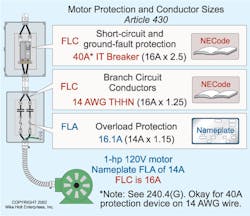
(a) The branch-circuit conductors can be 14 AWG THHN.
(b) Overload protection is from 16.1A.
(c) Short-circuit and ground-fault protection is permitted to be a 40A circuit breaker.
(d) All of these are true.
Walking through each of these, you can see:
(a) The conductors are sized per 430.22(A): 16A×1.25=20A; Table 310.16 requires 14 AWG at 60°C.
(b) Per 430.32(A)(1), overload protection is sized as follows: 14A (nameplate)×1.15=16.1A.
(c) Short-circuit and ground-fault protection is determined based on 430.52(C)(1): 16A×2.50=40A circuit breaker.
Therefore all three statements are true.
The 16A overload protection device protects the 14 AWG conductors from overcurrent, while the 40A short-circuit protection device protects them from short circuits. This example illustrates the sometimes confusing fact that when you're doing motor calculations, you're actually calculating overcurrent and short-circuit protection separately.
Motor calculations have long been a source of confusion and errors for many people. Understanding what makes these calculations different should help you do your motor calculations correctly every time.
For more information, read "Motor Calculations -- Part 1" and "Motor Calculations -- Part 2."
About the Author

Mike Holt
Mike Holt is the owner of Mike Holt Enterprises (www.MikeHolt.com), one of the largest electrical publishers in the United States. He earned a master's degree in the Business Administration Program (MBA) from the University of Miami. He earned his reputation as a National Electrical Code (NEC) expert by working his way up through the electrical trade. Formally a construction editor for two different trade publications, Mike started his career as an apprentice electrician and eventually became a master electrician, an electrical inspector, a contractor, and an educator. Mike has taught more than 1,000 classes on 30 different electrical-related subjects — ranging from alarm installations to exam preparation and voltage drop calculations. He continues to produce seminars, videos, books, and online training for the trade as well as contribute monthly Code content to EC&M magazine.