Back to Basics: ECM’s 2012 Top 30 Electrical Design Firms Special Report

Editor’s note: It has always been the mission of EC&M to eventually showcase the top players in the electrical design field in this article series. To that end, this year’s list includes only the firms that could break out total revenue by electrical design services. As such, we have narrowed the list from 40 firms to the Top 30. Although we are disappointed to lose the participation of certain firms, we are proud to offer a list that is more in line with our position as an authority on the electrical industry. EC&M congratulates all the firms that made it onto the 2012 Top 30 Design Firms list.

As a result, in answer to a proprietary survey, the companies on EC&M’s 2012 Top 30 Electrical Design Firms list earned $1.1 billion in revenue related to electrical design services in 2011 (click here to see the Top 30 Electrical Design Firms List). By comparison, last year, 27 design firms reported $553.9 million in revenue related to electrical design services for 2010. In addition, the 17 design firms on this year’s list that also reported revenue related to electrical design services in last year’s survey averaged a year-over-year increase of 6.1%.
Of these 17 firms, 10 experienced year-over-year increases in revenue related to electrical design services. Furthermore, of those 10, half experienced an annual increase of more than 20% in revenue related to electrical design services — Albuquerque, N.M.–based Bridgers & Paxton Consulting Engineers, Inc., (No. 21) with 48.4%; Edmonton, Canada–based Stantec, Inc. (No. 3) with 24.2%; Englewood, Colo.–based CH2M Hill (No. 2) with 21.1%; Portland, Ore.–based Interface Engineering for Architecture (No. 17) with 20.4%; and Jackson, Mich.–based Commonwealth Associates (No. 8) with 20.2%. Only two firms — Spark, Md.-based KCI Technologies, Inc. (No. 26) with -36.4% and Seattle-based Sparling (No. 14) with -10.3% — disclosed a drop in revenue related to electrical design services in the double digits.
“We are seeing increased activity in our electrical engineering services across the United States and internationally,” says David Bloxom, P.E., VP of electrical and control systems practice, Western Region, Tetra Tech, Inc. “One key area of expansion for Tetra Tech is in natural resources projects. Mining and oil shale projects require a great deal of our engineering expertise, and not just for the regular extraction operations, but also for the related environmental projects, such as water treatment plants. We are also seeing increased activity in municipal control systems (SCADA) projects in the United States, primarily in Southern California.”
Evidence of Recovery
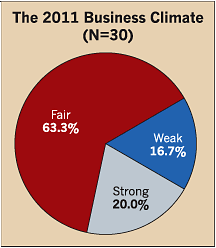
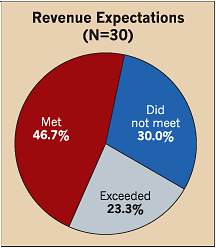
The EC&M survey posed several questions regarding the business climate and revenue expectations in 2011 and 2012. Just under two-thirds of the Top 30 firms described the 2011 business climate as “fair,” while the remaining companies were split between “strong” and “weak” (Fig. 1). Almost half the firms on the list reported meeting their revenue expectations for 2011 (Fig. 2). Still, 30% disclosed they did not meet revenue expectations last year. Only 23.3% exceeded revenue expectations in 2011.
Pressure to provide more services for smaller fees contributed to the perception of a weak business climate. “In the past year, we have seen clients asking for more services but not willing to pay additional money due to their budgetary issues,” says Shreedhar Shah, president, Gaithersburg, Md.-based Shah & Associates, Inc. (No. 30), which specializes in custom-designed traditional and alternative energy solutions. “While we sympathize, we can’t simply do work and not be compensated for it. We sit down with clients and ask them to reduce scope or alter the design criteria, among other things, so that both the client and engineer develop a solution that’s win-win.”
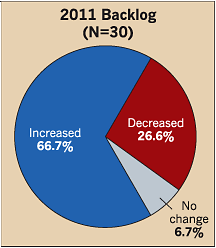
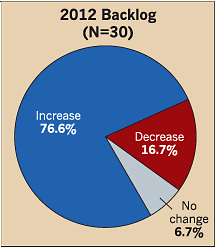
Despite these attempts by owners to diminish margins, the Top 30 firms revealed optimism in their answers to questions regarding 2012. Almost half the companies on the Top 30 list are expecting an increase in revenue of 6% or more this year (click here to see Fig. 3). Only one company is expecting a decrease in revenue this year, albeit more than a 10% increase. Perhaps based on the increase in backlog two-thirds of the companies experienced in 2011 (Fig. 4), the majority of companies — 76.6% — on this year’s Top 30 Electrical Design Firms list predict a further increase in backlog in 2012 (Fig. 5).
Yet, there remains caution in these predictions. Madison, Wis.-based Affiliated Engineers, Inc. (No. 7) experienced a slight uptick in its backlog in the second half of 2011. Based on this, it expects its backlog to remain at this level, but only in the short term — up to three months. “We are not seeing nor do we expect to see the ‘up to 12 months’ of solid workload seen a few years ago,” says Julie Bauer, director of marketing, Affiliated Engineers, Inc.
Strategic Acquisitions
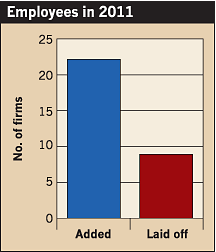
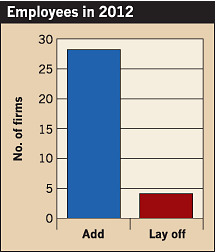
Another sign of the industry’s recovery lies in employment numbers. Although construction unemployment remained at around twice the level of general unemployment for most of 2011, 22 firms on the Top 30 list reported adding employees last year, whereas only nine revealed laying off employees that year (Fig. 6). Additionally, 28 firms on the Top 30 list are expecting to hire additional employees in 2012, with only four planning to lay off employees (Fig. 7).
For example, despite the slow recovery in the construction industry, Kansas City, Mo.-based employee-owned Burns & McDonnell (No. 1) added around 300 employee-owners in 2011. Of that total, approximately half the new positions were added in Kansas City and the other half in regional offices across the country. By 2011 year-end, the total head count in Kansas City totaled around 2,200, with 3,300 employee-owners nationwide. Furthermore, at the end of August, the company announced plans to add 1,000 jobs nationwide, including 500 in its Kansas City workforce by year-end 2013. The three-year growth projections should push total employment nationwide past the 4,000 mark, with 2,700 based in Kansas City.
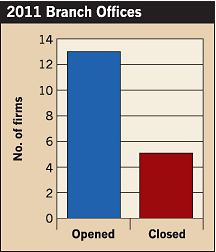
Some future hiring plans may be thwarted by staffing shortages caused by qualified personnel leaving the industry during the recession. Instead of poaching individual employees from other firms, however, some of the firms on the Top 30 list have chosen to join forces with smaller, boutique firms to acquire skilled employees and reach into additional active markets or geographical areas. Largely through mergers and acquisitions, 13 firms on the Top 30 list reported opening one or more branch offices in 2011, while only five said they’d closed one or more branch offices (Fig. 8).
“The engineering and construction industry has been impacted by the economy, and, as a result, there have been fewer projects available to companies,” says Kent Goetjen, assurance partner in PwC’s Hartford office and the firm’s U.S. engineering and construction industry sector leader. “As such, you see companies competing for lower margins. At the same time, projects are becoming complex, so the larger companies tend to compete for the complex projects from a merger and acquisition standpoint, at least based upon PwC’s quarterly survey.”
According to the PwC fourth quarter 2011 M&A survey, the majority of deal activity for engineering and construction in the fourth quarter of 2011 was from small, bolt-on acquisitions, which dropped the average deal value to 2009 low levels of $354 million. In the first quarter 2012 M&A survey, deal values dropped even further. Recovery is uncertain, so investors stay on the sidelines, according to the report.
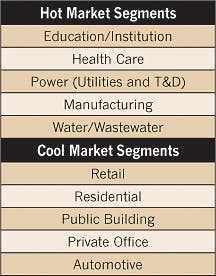
The lack of investors, however, has been made up for through strategic acquisitions. “Strategic investors are looking at particular types of companies to acquire with specific skills,” says Goetjen, who also says firms are acquiring other firms to move into a particular geography or market, particularly those that are currently active. “We’re seeing activity more so in the foreign markets than the U.S. markets, especially in the Asian markets,” he says. “Our first quarter survey shows that the transactions are gravitating toward those parts of the engineering and construction industry where there are large projects, such as infrastructure, water treatment, energy — those types of projects where there is a demand and funding alternatives.” (For the Top 30’s hottest markets, see Table 1. In July, Stantec signed a letter of intent to acquire Bonestroo, a St. Paul, Minn.-based engineering, planning, and environmental science firm with approximately 275 employees and offices in Minnesota, Wisconsin, Illinois, Michigan, and North Dakota. Furthermore, already this year, the firm signed a Letter of Intent to acquire ABMB Engineers, a Baton Rouge, La.-based firm that provides transportation, traffic, and infrastructure engineering, as well as intelligent transportation system design. “With ABMB as part of our team, we’ll continue to strengthen our U.S. transportation practice and create a strong foundation for growth across the Gulf Coast region,” said Bob Gomes, Stantec’s president and CEO, in a press release announcing the transaction.
Additionally, this year, the firm signed a letter of intent to acquire PHB Group, St. John’s, Canada, which provides architectural and interior design services as well as a full range of pre-design services, such as site selection studies, life-safety studies, building condition reports, feasibility studies, master planning, programming, and project management services. “PHB Group will be Stantec Architecture’s first architectural presence in Atlantic Canada,” stated Leonard Castro, VP responsible for Stantec’s architectural practice in Canada, in a press release announcing the transaction.
Stantec isn’t alone in its consolidation. In January, CDM, from last year’s list, joined forces with Wilbur Smith Associates to begin serving clients as a fully integrated provider of comprehensive water, environment, transportation, energy, and facilities services under the name CDM Smith. The consolidated firm represents almost 6,000 employees in 100 technical specialties, partnering with clients to solve challenges in 28 countries around the world.
In May 2011, Englewood, Colo.-based CH2M Hill (No. 2) announced that it had signed a definitive purchase agreement, to be finalized in the third quarter of that year, to acquire Booz Allen Hamilton’s State & Local Government Transportation Consulting (S&L Transportation) business. Booz Allen Hamilton has been a nationally recognized service provider to transit and rail agencies, with more than 35 years of experience providing management consulting, system engineering, rolling stock consulting, asset management, train control and communications systems, system safety, and revenue system consulting throughout North America.
“We are excited to welcome the transit and rail professionals from Booz Allen Hamilton’s S&L Transportation business to the CH2M Hill family,” said Transportation President Garry Higdem. “Their long track record of supporting top-tier U.S. and Canadian transit agencies with a wide range of management and consulting services blends perfectly with CH2M Hill’s transit and rail planning, design, construction, program management, and operations capabilities. This combined services portfolio creates a strong value proposition for our clients around the world.”
In fact, in June 2011, the firm announced it had added a mergers and acquisitions specialist to its staff when Matthew McGowan joined the firm as senior VP of corporate development. “Matt McGowan is an industry leader with a consistent track record of completing both domestic and cross-border deals,” said Mike Lucki, CH2M Hill CFO. In his role, McGowan is responsible for the oversight and leadership of merger and acquisition activities for the global firm, including identification of new opportunities, due diligence, negotiation, and post-merger integration. Additionally, McGowan will spearhead the firm’s public private-partnership (P3) initiatives.
Yet, some mid-size and smaller boutique firms have no interest in adding bulk or consolidating with larger players. They feel their specialized services would suffer under a larger umbrella. “Clients have been commenting to us that there is a lack of good power systems design firms,” says Shah. “We concur, as we have discovered that clients could have saved tens of thousands of dollars if their electrical designs were better thought out and incorporated the latest design concepts. These mistakes are largely on the part of larger multi-discipline firms that simply don’t have the technical expertise anymore, as the talent pool for power systems engineers is shrinking.”
Special Delivery
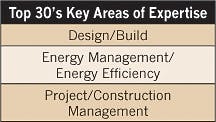
Along with creative financing options, the use of alternative delivery methods experienced growth in 2011. When reporting on their key areas of expertise, the Top 30 electrical design firms revealed that design-build gained more traction last year (Table 2).
Burns & McDonnell provided full design-build services for building modifications at Halls Crown Center in preparation for the new SEA LIFE aquarium in Kansas City, Mo. The recently opened 30,000-square-foot, two-story aquarium features 30 displays of salt water and freshwater marine life species. Under a contract with Crown Center Redevelopment Corp., Burns & McDonnell provided a range of design-build services, including architectural design, mechanical and electrical engineering, construction project management, estimating, and construction services. The project involved clearing the interior space on two floors of the Halls Crown Center department store, making structural modifications to accommodate large aquarium tanks and displays, modifying mechanical and electrical systems, and implementing new exterior entrance features.
Burns & McDonnell worked closely with Crown Center throughout demolition and construction to ensure the entire project met the company’s standards of environmentally responsible management and disposal of waste materials and installation of materials within the building envelope.

Many firms also incorporated energy conservation and sustainability into their designs. All but two of the firms on the Top 30 list reported that at least some of their firm’s work was based on green and energy-efficient design in 2011 and into 2012. In fact, eight firms estimate that more than 75% of their designs contain green and energy-efficient principles, with at least two claiming as much as 100%.
“The majority of our work includes some form of energy conservation or green design,” says Bauer of Affiliated Engineers, Inc. “Almost all clients are looking for energy efficiencies in their building systems. This will continue to be the majority of our work as the little money clients do have to spend is being invested in MEP and utility infrastructure to operate buildings and campuses more efficiently and economically.”
This trend has continued into 2012 and is expected to carry beyond this year. In January, Folsom, Calif.-based Glumac (No. 19) relocated to a new 15,150-square-foot LEED Platinum-designed office space. Sustainability was targeted as a primary goal for the design, which called for LEDs in more than 50% of luminaires, vacancy and occupancy sensors for all lighted spaces, daylight sensors for all luminaires in daylight areas, wireless controls and switches for all lights, and motorized blinds. To make all employees aware of energy usage, Glumac is installing a custom energy dashboard to show real-time and past energy use. This will lend insight into identifying trends and anomalies of the heating, cooling, and control systems and give Glumac the ability to make system changes in the future to ever-improve energy usage.
All but two firms on the Top 30 list reported including a renewable energy component in a percentage of their work, as well. Although percentages varied from 0.5% to an average 20%, one firm claimed that 90% of its work includes a renewable energy component.
In 2011, CH2M Hill announced completion of a first-of-its-kind modeling tool designed to promote the expansion of solar energy in the United States. The project was completed as part of the company’s ongoing support of the U.S. Department of Energy’s Solar America Communities program. The tool is intended to help communities understand how and when solar energy will become economically viable in various regions of the United States. The PV Cost Convergence Model provides valuable information about grid parity time lines and solar incentive scenarios for 25 cities across the United States, and forecasts when distributed PV energy costs may become competitive with existing grid electricity. CH2M Hill’s Cost Convergence Model can be accessed at www.PVcostconvergence.com.
Sidebar: Join the List
Is your electrical design firm or division one of the bigger players in the nation? If so, we’d like to hear from you. To get on the list to receive the proprietary survey for next year, please contact Staff Writer Beck Ireland at [email protected] or call (913) 967-1806.