Picture This
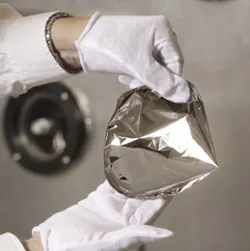
What it's not: A breast implant for the bionic woman.
What it is: An alloy membrane for hydrogen separation. Southwest Research Institute (SwRI) scientists, in collaboration with researchers at the Colorado School of Mines, are developing an ultra-thin, large-area, high permeability palladium alloy membrane for hydrogen gas separation. This three-year, $1 million development effort is funded by the U.S. Department of Energy's National Energy Technology Laboratory. The ability to produce pure hydrogen has been a particular challenge that has impeded progress for two promising technologies for the efficient production of clean electricity: coal gasification and fuel cells. Hydrogen is costly to produce or to separate from gas mixtures, such as reactor effluent or waste streams, due to the high capital and energy expenditures associated with compression, heat exchange, cryogenic distillation, and pressure swing adsorption (PSA). SwRI scientists believe that an affordable, tough, and selective hydrogen separating membrane, on the other hand, could significantly reduce these costs, and ultimately replace traditional unit operations or be integrated into an existing process to recover hydrogen.