Sometimes, it makes sense to “tap into” a feeder conductor to power another conductor. From Art. 100, we know that a feeder conductor runs between service equipment (or a similar source) and the branch-circuit overcurrent protective device (OCPD). The conductor that's tapped into a feeder conductor is called the tap conductor.
Think about this arrangement for a second. The OCPD supplies the feeder. You tap the feeder, making the feeder OCPD also the OCPD for the tap conductor. The OCPD is situated ahead of the point of supply to the tap conductor because it's situated ahead of the feeder. Normally, you have to size the OCPD for the size and insulation of a given conductor, per 240.4. But in this arrangement, the OCPD is sized for the feeder conductor and is thus oversized for that tap conductor (not sized per 240.4). In such a situation, you have a feeder tap [240.2].
How do you keep your feeder tap from burning up? Getting an answer to that question is why we have 240.21(B), which provides the requirements for feeder taps. Unfortunately, 240.21(B) can easily confuse anyone trying to apply it. The first step in avoiding that problem is to understand two basic rules that apply to all feeder taps.
-
You can't tap a tap; that is, don't use a tapped conductor to supply another conductor. This rule isn't explicitly stated, but:
-
You can infer this rule from the first paragraph of 240.21(B).
-
By definition, a feeder tap is to a feeder, not to a tap.
-
-
No upsizing. This rule is explicitly stated in the first paragraph of 240.21(B): “The provisions of 240.4(B) shall not be permitted for tap conductors.”
The “next-size-up protection rule” [240.4(B]), which you can use for nontapped conductors, allows you to use the next highest OCPD above the ampacity of the conductors being protected. If you were trying to protect a 1 AWG feeder conductor, you'd go to Table 310.16 and see the conductor is rated at 130A. You could use a 150A circuit breaker (next size up) [240.4(B)]. In a feeder tap situation, however, you can't do that.
Does this mean you have to size the feeder tap conductor to fit the OCPD, instead of the other way around? Well, sort of. Exactly how you size the tap conductor depends on its length and application — 240.21(B) provides five sets of requirements (let's call them “scenarios”).
These two basic rules for feeder taps are simple. It's the other rules that seem to lead to headaches and heartburn. So here's your next tip: Look at each of the five scenarios, and pick the one that applies.
Scenario 1: Taps supplying a transformer (primary plus secondary not more than 25 feet long).
Scenario 2: Outside taps of unlimited length.
Scenario 3: Taps not more than 10 feet long.
Scenario 4: Taps 10 to 25 feet long.
Scenario 5: Taps more than 25 feet long.
But how do you know which one to pick? Easy. You just have to answer three questions:
-
Will it feed a transformer with primary plus secondary not more than 25 feet long? If so, choose Scenario 1.
-
Is it being applied outdoors, and you don't want to be tied to a specific length? If so, choose Scenario 2.
-
For all other applications, how long is the tap conductor? Choose Scenario 3, 4, or 5.
Each scenario has different requirements, though you will find similarities. If you compare this list of scenarios to what's actually in 240.21(B), you'll see we present them in a different order.
Scenario 1: Taps supplying a transformer (primary plus secondary not more than 25 feet long).
Obviously, you can't exceed 25 feet in the total length of the primary and secondary conductors if you want to supply transformers via tap conductors (the exception being Scenario 2). The other requirements are as follows:
- Size the primary tap conductors to an ampacity that's at least one-third of the ampacity of the OCPD that protects the feeder conductors.
- Size the secondary tap conductors to an ampacity that, when multiplied by the ratio of the primary-to-secondary voltage, is at least one-third the rating of the OCPD that protects the feeder conductors.
- Protect primary and secondary conductors from physical damage by enclosing them in a manner approved by the authority having jurisdiction (AHJ), such as within a raceway. You'll notice this requirement in the other scenarios, except Scenario 3.
- Terminate the secondary conductors to a single circuit breaker (or set of fuses) rated no more than the tap conductor ampacity per 310.15 [Table 310.16].
Scenario 2: Outside feeder tap of unlimited length.
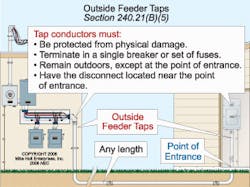
Outside feeder tap conductors can be of unlimited length without an OCPD at the point they receive their supply if they are (Fig. 1 on page 48):
- Protected from physical damage (enclosed in a manner approved by the AHJ, such as within a raceway).
- Terminated at a single circuit breaker or a single set of fuses that limits the load to the ampacity of the conductors. This is how you get the “unlimited length” part, and it's why there's no 10% rule or one-third rule in this scenario.
Also:
- The OCPD for the tap conductors must be an integral part of the disconnecting means or must be located immediately adjacent to it.
- The disconnecting means must be in a readily accessible location, either outside the structure or nearest the point of entry of the conductors.
Scenario 3: Tap not more than 10 feet long
You can install feeder tap conductors up to 10 feet long without an OCPD to the tap, if the tap conductors (Fig. 2):
- Have an ampacity that is at least the calculated load per Art. 220 and the rating of the device or OCPD that the tap conductors supply.
- Have an ampacity that is not less than 10% of the ampacity of the OCPD that protects the feeder. Note that the previously stated condition might not allow you to take advantage of this “10% rule.”
- Don't extend beyond the equipment they supply.
- Are in a raceway, if they leave the enclosure.
The FPN under 240.21(B)(1) says to see 408.36 for the overcurrent protection requirements for panelboards.
Scenario 4: Tap 10 to 25 feet long
You can install feeder tap conductors up to 25 feet long without an OCPD on the tap, if they (Fig. 3):
- Have an ampacity that is at least one-third of the ampacity of the OCPD that protects the feeder.
- Terminate in a single OCPD (breaker or set of fuses) rated no more than the tap conductor ampacity per 310.15 [Table 310.16].
- Are protected from physical damage (enclosed in a manner approved by the AHJ, such as within a raceway).
Scenario 5: Tap more than 25 feet long
In an industrial application (only), you can run feeder tap conductors up to 100 feet without an OCPD on the tap, if they:
- Don't contain splices.
- Are 6 AWG copper or 4 AWG aluminum or larger.
- Have an ampacity at least one-third of the ampacity of the OCPD that protects the feeder.
- Don't exceed 25 feet length horizontally or 100 feet in total
- Don't penetrate walls, floors, or ceilings.
- Are protected from physical damage (enclosed in a manner approved by the AHJ, such as within a raceway).
- Are at least 30 feet from the floor.
- Terminate in a single circuit breaker (or set of fuses) rated no more than the tap conductor ampacity per 310.15 [Table 310.16].
Also, supervisors must ensure only qualified persons service such installations. This seems like an awful lot of requirements for an unlikely application — a tap conductor more than 25 feet long. However, things aren't always as they seem. The application is actually fairly common. Examples include high-bay manufacturing buildings and warehouses, which can easily have walls over 35 feet tall.
So, now you have an easy way to zero in on feeder tap conductor requirements. The next time a feeder tap project leaves you feeling tapped out, stop to answer three easy questions about your project. Then, pick the scenario that describes your application. It's all downhill from there.
About the Author

Mike Holt
Mike Holt is the owner of Mike Holt Enterprises (www.MikeHolt.com), one of the largest electrical publishers in the United States. He earned a master's degree in the Business Administration Program (MBA) from the University of Miami. He earned his reputation as a National Electrical Code (NEC) expert by working his way up through the electrical trade. Formally a construction editor for two different trade publications, Mike started his career as an apprentice electrician and eventually became a master electrician, an electrical inspector, a contractor, and an educator. Mike has taught more than 1,000 classes on 30 different electrical-related subjects — ranging from alarm installations to exam preparation and voltage drop calculations. He continues to produce seminars, videos, books, and online training for the trade as well as contribute monthly Code content to EC&M magazine.