The Secret to Understanding Arc Flash Calculations
A few years ago, the term “arc flash” crept into our electrical technical vocabulary. Since that time, performing arc flash calculations remains a challenge for many of us. Calculating incident energy levels and arc flash boundary distances for the purpose of estimating the hazard risk category (HRC) a worker would be exposed to while working on electrical equipment opens a window into the inner workings of the power distribution system. Arc flash calculations can tell us a great deal about how the system will behave during a fault condition. They also offer us a golden opportunity to optimize the system for safety and attempt to prevent the hazard from happening in the first place.
Arc flash regulations may be one of the best things that have ever happened to electrical designs, because they force engineers to look closer at details they might have otherwise overlooked in the past and put the power system calculations front and center in the design process. The very notion of considering arc flash early on in the design of a power distribution system is not only prudent, but also economical.
The following two documents are the foundation for truly understanding arc flash calculations:
- NFPA 70E, Standard for Electrical Safety in the Workplace, 2012 Edition
- IEEE Std 1584, Guide for Performing Arc-Flash Hazard Calculations, 2002 Edition
In this article, we’ll concentrate on NFPA 70E instead of IEEE Std 1584. The calculations shown below will also focus on alternating current systems.
Chapter 1, Safety-Related Work Practices (Art. 100 Definitions)
The definitions in Chapter 1 include the terms used in the calculations, which help you understand the concept.
Boundary, arc flash. When an arc flash hazard exists, an approach limit at a distance from a prospective arc source within which a person could receive a second-degree burn if an electrical arc flash occurred.
Boundary, limited approach. An approach limit at a distance from an exposed energized electrical conductor or circuit part within which a shock hazard exists.
Boundary, prohibited approach. An approach limit at a distance from an exposed energized electrical conductor or circuit part within which work is considered the same as making contact with the electrical conductor or circuit part.
Boundary, restricted approach. An approach limit at a distance from an exposed energized electrical conductor or circuit part within which there is an increased risk of shock (due to electrical arc-over combined with inadvertent movement) for personnel working in close proximity to the energized electrical conductor or circuit part.
Ground Fault. An unintentional, electrically conducting connection between an ungrounded conductor of an electrical circuit and the normally non-current-carrying conductors, metallic enclosures, metallic raceways, metallic equipment, or earth.
Incident energy. The amount of energy impressed on a surface, at a certain distance from the source, generated during an electrical arc event. One of the units used to measure incident energy is calories per centimeter squared (cal/cm2).
Incident energy analysis. A component of an arc flash hazard analysis used to predict the incident energy of an arc flash for a specified set of conditions.
Qualified person.One who has skills and knowledge related to the construction and operation of the electrical equipment and installations — and has received safety training to recognize and avoid the hazards involved.
Unqualified person. A person who is not a qualified person.
Short circuit current rating. The prospective symmetrical fault current at a nominal voltage to which an apparatus or system is able to be connected without sustaining damage exceeding defined acceptance criteria.
Informative Annex C, Limits of Approach
Annex C introduces the following logical concept:
“As the distance between a person and the exposed energized conductors or circuit parts decreases, the potential for electrical accident increases.”
It also breaks down the discussion of safe approach distance for both unqualified and qualified persons.
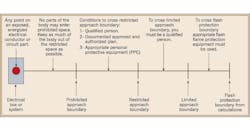
The Annex also illustrates the limits of approach, the basic concept of which is illustrated in Figure 1:
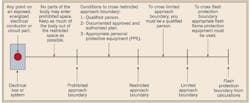
Table 130.4(C)(a) of NFPA 70E introduces “Approach Boundaries to Energized Electrical Conductors or Circuit Parts for Shock Protection, Alternating-Current Voltage Systems.” The prohibited approach boundary, restricted approach boundary, and limited approach boundary are all dependent on system voltage.
Informative Annex D, Incident Energy and Arc Flash Boundary Calculation Methods
Annex D introduces five sets of equations to calculate the arc flash boundary and/or the incident energy level. It also provides formulas for calculating arc flash energies and boundaries to be used with current-limiting Class L and Class RK1 fuses as well as with circuit breakers. This Annex also includes numerical examples that demonstrate the calculation procedure.
The equations in this Annex can be used for low-voltage and medium-voltage systems, but each has its own limitations. Thus, the reader must use the set of equations that best suits his/her application. The limitations are in terms of voltage, short circuit current range, open air space, or inside a cubical (applicable to arc flashes emanating from within switchgear, motor control centers, or other electrical equipment enclosures).
For typical low-voltage applications (<600V), these equations seem to best fit.
The following equation is used to estimate the incident energy in a cubic box (20 in. on each side):
EMB = 1038.7 DB-1.4738 tA [ 0.0093F2 - 0.3453 F + 5.9675 ]
Where:
EMB: is the maximum 20-inch cubic box incident energy in cal/cm2.
DB: is the distance from arc electrodes in inches. DB is the working distance and it is 18 in. for low-voltage application the origin of this value is in NFPA 70 Table 110.26(A)(1) Working Space (Low Voltage).
F: is the short circuit current, kA (for range of 16kA to 50kA), for the circuit under consideration.
tA: is the arc duration in seconds. To calculate tA, first calculate the arc fault current (IA) from the following equation:
log(IA) = K + 0.662log(Ibf)+0.0966V+0.000526(G) + 0.5588(V)log(Ibf)-0.00304(G)log(Ibf)
Where:
IA: is the arc fault current.
Ibf: is the bolted short circuit current (3-phase symmetrical rms kA).
G: is the gap between conductors or buses. Obtain the value of G from Table D.7.2 Factors for Equipment and Voltage Classes.
K: -0.153 for open air or -0.097 for “In Box.”
V: is the system voltage (0.208kV to 15kV).
Then, calculate IA = 10 lg IA
Time is the most controllable factor in the amount of incident energy and can be controlled by the settings of the upstream circuit breaker during the time current characteristics TCC coordination study. The time can be directly obtained from protective device time current characteristics TCC curve. The maximum value for the time to be used in calculations is 2 sec.
For 480V systems, the industry accepted minimum level for a sustaining arcing fault is 38% of the available bolted fault, 3-phase short circuit current. The highest incident energy exposure could occur at these lower levels where the overcurrent device could take seconds or minutes to open.
Notice that you can use 0.85 × IA to find a second arc duration. This second arc duration accounts for variations in the arcing current and the time for the overcurrent device to open. Calculate the incident energy using both arc durations (Ia and 0.85 × IA), and use the these two values to obtain from the TCC of the upstream protective devices two values for tA. Then calculate the incident energy and use the largest amount.Another set of data you will find useful when performing arc flash calculations is the 480V portion of Table D.7.7, “Incident Energy and Arc Flash Protection Boundary by Circuit Breaker Type and Rating 480V and Lower”:
|
Rating |
Breaker |
Trip Unit |
Incident Energy |
Arc Flash |
|
100 to 400 |
MCCB |
TM or M |
0.189 Ibf + 0.548 |
9.16 Ibf+ 194 |
|
600 to 1,200 |
MCCB |
TM or M |
0.223 Ibf + 1.590 |
8.45 Ibf + 364 |
|
600 to 1,200 |
MCCB |
E, LI |
0.377 Ibf + 1.360 |
12.50 Ibf + 428 |
Notes:
Ibf is based on a working distance of 455 mm (18 in.). Ibf is between 700A and 106,000A.TCC curves are not necessary when Ibf is in the range above.
The equations above can be used for checking calculations or in lieu of detailed calculations.
The incident energy is in joule/cm2 and needs to be converted to cal/cm2 as follows: 1 J/cm2 = 0.238902957619 cal/cm2Informative Annex H, Guidance on Selection of Protective Clothing and Other Personal Protective Equipment
Table H.3(b) provides guidance on selection of arc-rated clothing and other personal protective equipment (PPE) for use when incident exposure is determined by a hazard analysis. By calculating the incident energy, you can determine the HRC. Then use table H.3(b) to determine PPE.
Table H.4(a) for low-voltage systems introduces maximum 3-phase bolted fault-current limits at various system voltages and fault clearing times of circuit breakers for recommended use of 8 cal/cm2 and 40 cal/cm2 PPE in an “arc-in-a-box” situation.
Table H.4(b) for high-voltage systems introduces maximum 3-phase bolted fault-current limits at various system voltages and fault clearing times of circuit breakers for recommended use of 8 cal/cm2 and 40 cal/cm2 PPE in an “arc-in-a-box” situation.
Tables H.4(a) and H.4(b) can really help during the design and review stages of an arc flash study. These two tables can be used in several ways, as follows:
- Knowing the maximum 3-phase fault current, a maximum value of the upstream protection fault clearing time can be established in order to achieve an HRC value of 2 or 4.
- Knowing the 3-phase fault current at a point in the system and upstream circuit breaker clearing time, you can use the Tables to check the calculations if you are reviewing a study without actually performing the calculations yourself.
- You can establish a maximum for the 3-phase short circuit current in a new system, and use it as a criterion for the design.
In conclusion, arc flash regulations have brought a great deal of challenge to the industry, but also present a great opportunity to improve the electrical safety and the quality of a power distribution system design. Electrical designers and project reviewers alike should look to arc flash calculations as a tool for continued improvement.
Elgazzar is a senior electrical power engineer for the federal government and is currently registered as a professional engineer in the states of Virginia and South Carolina. He can be reached at [email protected].